


A Brief Discussion on the Two-wing through-Back
2022-08-20 23:32:13
The Two Wings Connecting Arms is a major school of the Connecting Arms Boxing series. It was originally called the Two Xi Yuan Boxing. Due to the fact that the movement route and techniques of this boxing, such as the swinging of the door and the insertion of the moves, mostly use left and right arc-shaped movements, it was later renamed "Two Wings Connecting Arms". This boxing style was passed down by Liu Yi, a native of Shandong. It is said that he once participated in the peasant uprising led by Song Jingshi. After the failure, he left him and took refuge in Yanjiawu, Ji County, Hebei Province during the Tongzhi period to teach martial arts. The first two people to learn from him were Zhang Laoshi and Zhang Zhili. Later, each of them passed on a branch: Zhang Laoshi followed one branch to the area around Renqiu County, Hebei Province. Zhang Zhili, due to his family's poverty, left for Nangezhuang, Daxing County, Hebei Province to teach students. His disciples include: Xiao Jianjunzhang, known as the Lightning Hand, yuan Ruilin, who drills the sky hawk, and 倨 yongxiang, who runs the Yongfeng Escort agency in Beijing. Among the successors of the two Wings of the Qing Dynasty, it is particularly worth mentioning Mr. Zhao Xiongwan. During the War of Resistance against Japanese Aggression, Mr. Zhao participated in the revolution and later went to Tianjin to perform as a cover for revolutionary work. During this period, he also collected a few disciples, such as Mr. Gu Fengming and Mr. Wang Jincheng. Although the Two-Wing Pass has a history of over a hundred years, due to its strict transmission, very few people have truly grasped its essence. As a result, this excellent boxing style, which is on par with Fanzi, PI Gua and Cha Jiao, is on the verge of being lost. Nowadays, it is very rare to see those who publicly perform it. Here is a brief introduction to this boxing style for the readers' enjoyment. The characteristics of the two-wing arm movement are: flexible steps, two-wing operation, diverse variations such as crawling, flipping, twisting and turning, flashing, swinging, splitting and slicing, every move follows each other, every posture is connected, the techniques are practical and precise, the routines are concise and powerful, the usage is unique and distinctive. The techniques include: splitting, breaking, supporting, piercing, picking, cutting, intercepting, copying, pressing, colliding, chopping, and poking, etc. The leg techniques include: blocking, lifting, kicking, stepping on, sweeping, hooking, and tapping, etc. The footwork methods include: carrying forward steps, raising steps, sitting and limping steps, wave steps, longitudinal steps, side pole steps, twisting and turning steps, twisting and turning steps, cutting steps, and twisting steps, etc. The boxing routine consists of twelve consecutive moves (Twelve consecutive punches), which are further divided into the first six moves and the last six moves. The first six moves mainly focus on leg techniques, while the last six emphasize the application of techniques. When practicing, the sixth move (combination) can be practiced alone or strung together to form a complete routine. The names of the movements are as follows: The first six moves: 1. Piercing through the forest and touching the shade, lifting and kicking the leg. Second, step back to change the figure and kick the legs. Three: Wild horses gallop into the trough with a single kick. Four. Use a reverse bow force to hook the leg. V. Inflection trend, point the legs. Six. Dark clouds overhead, twist the net leg. The last six moves: First, the retraction move, double interception. Second, take a lateral step with a crouching posture. Three, lift, twist and turn, flash and split palm. Four. Through a series of steps, one hand spreads out. Five. Swinging the door with five flowers. Serial guns. Six. Make a decision on the spot and block the mountain leg. Reposted from: "Wu Hun"
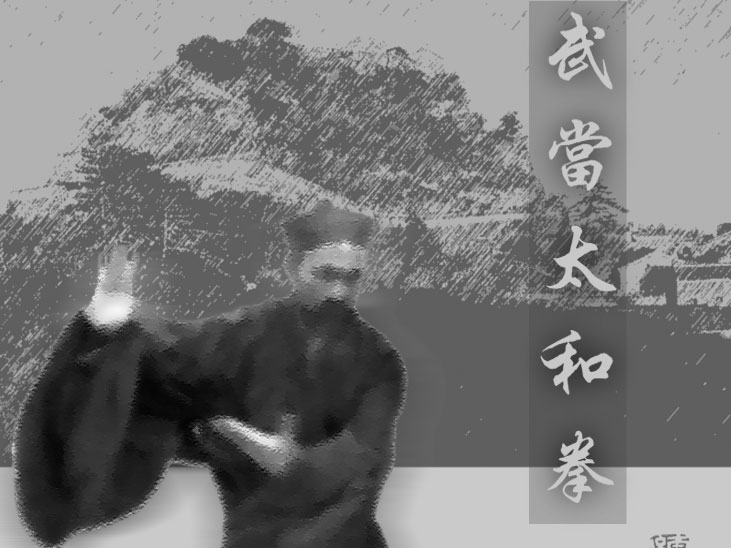
Verified by Zhang Sanfeng with the same name and pronunciation
2022-08-20 23:32:13
The main hall of Taizi Rock
Annotations on the 24 Poems of Jin Dan ⑥
2022-08-20 23:32:13
The tomb statue of Taoist Priest in Wulong Palace
Commentary on the Taiji Elixir Classic: "A Simple Explanation of Dao Yan" ①
2022-08-20 23:32:13
The white tiger in the Dragon and Tiger Hall of Fuzhen Templ...
"Xuan Yao Chapter - Part 1: A Song about Taoist Love.
2022-08-20 23:32:13
The dougong brackets in the main hall of Fuzhen Temple