


(II) Overview of the Development of sacrificial Ceremonies
2022-08-20 23:32:13
Sacrificial ceremonies and prayers have existed since ancient times. As early as before the Eastern Han Dynasty, there were concepts such as "fasting", "jiao", and "tan", which are all recorded in books like "The Book of Rites", "The I Ching", "The High Tang Fu", and "Records of the Grand Historian", indicating that the Taoist ritual of fasting and jiao originated from ancient Chinese prayer rituals. During the Eastern Han Dynasty, before the birth of Taoism, in the eighth year of Yongping of Emperor Ming of Han (65), the imperial court issued an edict to King Ying of Chu, ordering him to recite the fine words of Huang-Lao, visit the Ren Ci of Futu, have a three-month clean feast, and swear an oath with the gods. After the birth of Taoism, Emperor Huan of Han personally worshipped Laozi in Zhuolong, made an altar with brocade, decorated it with pure gold ornaments, set up a seat with a grand lid, and used the celestial music of the Jiao (see the "History of the Later Han Dynasty"). It can be seen that at this time, the sacrificial ceremony and prayer not only had altars and offerings, but also music - the suburban celestial music. Within the imperial court, the worship of "Huang-Lao" and "Futu" (Buddha) was conducted using the ancient Chinese "Jiezhai" ceremony, with the recitation of "The subtle Words of Huang-Lao" and the accompaniment of the ancient Chinese music "Jiao Tian Le". This indicates that after Buddhism was introduced to China, it was quickly integrated into traditional Chinese culture, and traditional Chinese sacrificial rituals were used to worship Buddha. It also shows that traditional Chinese sacrificial rituals have not changed due to the introduction of Buddhism. During its emergence, Taoism inherited and developed the ancient Chinese sacrificial rituals, rather than absorbing the rituals of Buddhism as some people think. During the Eastern Han Dynasty, the Taiping Circuit already had rituals such as praying to the heavens and expressing gratitude. The Five Pecks of Rice Ritual also has rituals such as the "Charcoal Coating Fasting" and the "Instruction Fasting". Worshippers "apply yellow earth to their faces and bind their heads upside down", and the rituals are simple. In addition, the Five-Peck Rice Way also has the "Three Officials' Handwritten Notes" for praying to the sick. The specific practice is: "Write the patient's surname and given name, expressing the intention to accept the crime." Make three connections: one is the mountain to ascend, one is the mountain to rest on, one is the place to be buried, and one is the submerged water. (See "Records of The Three Kingdoms: Biography of Zhang Lu") Although this kind of ritual is very simple, it already has the rudimentary form of the ritual badges used in the sacrificial ceremony. According to the "Biography of Shi Lao" in the "Book of Wei", at the beginning of Zhang Daoling's establishment of the religion, because he taught some of the vegetarian, ancestral hall and ritual methods in the "Tiangong Zhangben", his disciples "each mastered the Taoist methods", and thus "his deeds were carried out on a large scale". The Tianfu Zhangben can be regarded as the earliest book on religious ceremonies. In conclusion, this period was the pioneering stage of Taoist rituals, so the rituals were very simple in both content and form. However, it is undeniable that the ritual of the Taoist ritual of fasting and dipping emerged. During the Eastern Jin Dynasty and the Northern and Southern Dynasties, the Taoist priests of the Shangqing and Lingbao schools gradually developed a complete set of ritual norms and procedures through their calculations. In the second year of Xingning during the reign of Emperor Ai of the Eastern Jin Dynasty (364), Yang Xi and Xu Mi, disciples of Lady Wei, established the "Shangqing Dharma Altar" on Maoshan Mountain and used the seal of "Nine Elders Can Du Jun". During the Long 'an period of Emperor An of the Eastern Jin Dynasty (397-401), Ge Chaofu, a descendant of the Ge Hong clan, wrote over 30 volumes of the "Lingbao Sutra". In the Southern Dynasties, Lu Xiujing further revised and expanded it, making it widely circulated. He established the "Lingbao Xuan Tan" on Ge Zao Mountain and used the "Yuan Shi Zong Tan" seal and the "Yuan Shi Wan Shen" copper seal. During the Northern Wei Dynasty, Taoist priest Kou Qianzhi was the first to reform the northern Celestial Master Taoism, advocating propriety and changing the recitation of scriptures from "direct recitation" to "sound recitation". Since then, the recitation of scriptures during Taoist ceremonies has included musical content. Kou Qianzhi's writing of "The Sound in the Clouds Recites the Sincerity of New Science" and "the True scripture of 箓" further developed and improved the scientific instruments. After Kou Qian, Lu Xiujing, a Taoist priest of the Lingbao School of the Liu Song Dynasty in the Southern Dynasties, also reformed the southern Celestial Master Taoism. On the basis of writing the classics of the Three Caves, he refined the ritual of the sacrificial ceremony. He has written over a hundred volumes on the rituals of Taoist ceremonies, covering various rituals such as the six, nine, and twelve sessions of the Lingbao Festival, as well as many Taoist ritual music pieces like the "Xuxuan Bu Xu Zhang". After being compiled and revised by Kou Qianzhi and Lu Xiujing, the ritual of the sacrificial ceremony gradually took shape and became more complete. By the Sui Dynasty, it had basically come to a standstill, but was still highly valued. The ritual of fasting and dipping has been passed down through the Tang, Song and Yuan dynasties and has become popular along with the development of Taoism. In the 10th year of Kaiyuan (722) and the 29th year of Kaiyuan (741), Emperor Xuanzong of Tang ordered the establishment of a temple for Emperor Xuanyuan in each of the two capitals and various states, and held a ritual ceremony every year in accordance with Taoist rituals. During this period, he also "personally taught the Taoist priests the sound and rhyme of walking in the Taoist temple", and ordered Taoist priests such as Sima Chengzhen and Li Hanguang to compose "Xuanzhen Daoqu" and "Daluo Tianqu", etc. When Emperor Wuzong of Tang ascended the throne (841), he summoned eighty-one taoists including Zhao Guizhen into the Forbidden City and held a 金箓 monastery in the three halls. Emperor Xing visited the three halls and personally received the seal script at the Nine Heavens Altar. Du Guangting, a Taoist priest of the late Tang and Five Dynasties period, was the grand master of Taoist rituals and ceremonies. He collected, sorted out, compiled and stipulated various rituals and ceremonies since the Northern and Southern Dynasties. On this basis, many new books on Taoist rituals were compiled, such as "The First Reading of the 箓 Ceremony of the Supreme Lord", "The Ritual of the Three Sovereigns and Seventy-Two Kings' Studio of the Cave God", and "the Complete Collection of Taoist Rituals", which had a profound influence. During the reigns of Emperor Taizong, Emperor Zhenzong, Emperor Shenzong, Emperor Zhezong and Emperor Huizong of the Northern Song Dynasty, there was no Taoist ritual in the palace. Historical records never stop: In the second year of the Dazhong Xiangfu era (1009), Emperor Zhenzong ordered the Taichang Ritual Institute to meticulously determine the Taoist ritual for the Tianqing Temple and awarded it to all the prefectures. In the second year of the Daguan era (1108), Emperor Huizong issued the 金箓 Lingbao Taoist Precepts throughout the land and ordered Taoists to follow them in accordance with the law. During the Jin and Yuan dynasties, there were palaces and temples in the capital and famous mountains in the capital (such as Longhu Mountain and Gezao Mountain). Taoist ceremonies are held in places like Maoshan. Not only the Taoists of the Zhengyi School, but also the Quanzhen School's Qiu Chuji and Wang Chuyi, as well as the Taiyi School's Xiao Zhichong and Xiao Jushou, all successively followed the orders of the Jin and Yuan emperors to preside over the Taoist ritual. Thus, the practice of the Taoist ritual became common among all the schools. After the Ming Dynasty, Taoism declined, but sacrificial ceremonies and rituals still spread among the common people. At this stage, many folk religions emerged and spread widely. Many rituals and ceremonies were absorbed by folk religions. At the same time, many large-scale sacrificial ceremonies were lost due to the inability to host them, while small-scale ones, having been further simplified to better meet the needs of the general public, have been passed down to this day. During the Qing Dynasty, Lou Jinyuan, the director of the Shangqing Palace on Longhu Mountain, compiled 12 volumes of the ritual guard for the ritual into "黄箓 Ritual", which became a model of modern ritual.
One of the stars of the Big Dipper
2026-04-15 11:51:31
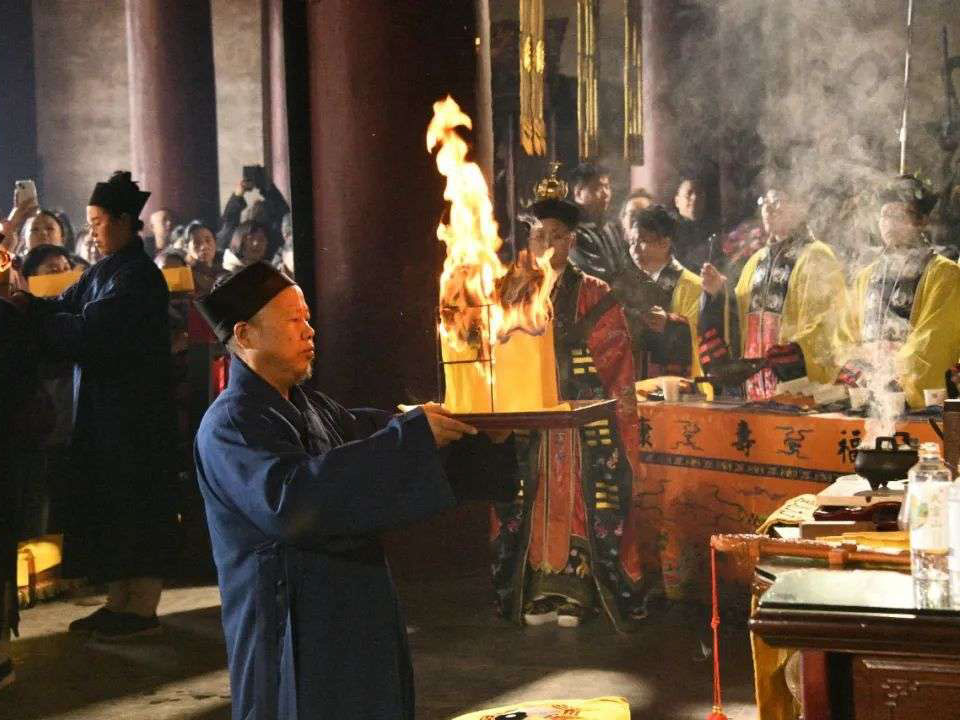
(1) The meaning of the ritual of fasting and Taoist ceremonies
2022-08-20 23:32:13
The original meaning of "zhai" was to be neat, harmonious an...
Yin GUI
2022-08-20 23:32:13
Chapter 27
2022-08-20 23:32:13
Chapter 72
2022-08-20 23:32:13
The couplet of the ancestral hall of the Wudang Mountain Temple
2022-08-20 23:32:13
The Wudang Taoist couplet congratulating the Rain
2022-08-20 23:32:13