


(5) Zhengyi Dao and Quanzhen Dao
2022-08-20 23:32:13
Since the Song Dynasty, Chinese society has been undergoing tremendous upheavals. In the process of historical evolution of Taoism. New ideas and thoughts are constantly emerging and being absorbed. Under the influence of different ideological consciousness, Taoist sects have been constantly recombining and developing in the process of inheritance and evolution. Of course, all of this is under the premise of the belief in the "Tao", and the deities and ancestral masters worshipped will not change much. However, regarding how to cultivate the Tao and in what way to practice it. There are different views and understandings between the Danding School and the 符箓 school. Even within the Dan Ding and 符箓 schools, there are different attempts and ways of thinking: for instance, within the Dan Ding school, there are disputes over viewpoints such as "nature before destiny", "destiny before nature", and "dual cultivation of life and nature" in the practice of alchemy. There were also disputes between laypeople and monastics. Eventually, all the schools and sects of the pure cultivation of alchemy were unified by the Quanzhen School. Among the 符箓 schools of Taoism, there are differences in internal cultivation combined with 符箓, or in the practice of 符箓 prayer and exorcism, impeachment and summoning, and incantations. The various schools such as Qingwei, jingming, Shenxiao, longhu, Maoshan, and Gezao, which took 符箓 as the main path of practice during the yuan and Ming periods, were formed into the zhengyi school. Since the Yuan Dynasty, Taoism has been divided into two major schools: the Zhengyi School and the Quanzhen School, which have been passed down to the present day. The following is an introduction to some information about the Quanzhen and Zheng sects. The Zhengyi School, also known as the Zhengdao or Zhengyi Sect, is a Taoist school formed after the great alliance of various 符箓 schools of Taoism. This sect inherits the forty-character Dharma school, also known as the "Three Mountains Dripping Blood School", which might have been established through a ceremony held when the 符箓 sects formed an alliance. The content is: "Adhere to the Dao and cultivate benevolence and virtue, restore the Supreme harmony with the true, spread the jade Canon with sincerity, perform the golden examination with loyalty and righteousness, break through the Han and reach the mysterious, reach the Great Luo with grandeur, cultivate the wonderful law of the Three mountains, and stir up the great waves in the four seas." Since the 14th year of Zhiyuan (1277), as the descendants of Zhang Ling were successively enfeoffed as celestial masters and entrusted with the responsibility of overseeing Taoism in the jiangnan region, the successive celestial masters gradually became the common leaders of the various 符箓 sects in the jiangnan region. Because the celestial masters of all dynasties have been particularly respected, the Dragon and Tiger Sect they led has gained favorable conditions for development. In particular, the development of its branch, the Xuan Sect, was on an unprecedented scale, which prepared organizational conditions for the formation of the Zheng School. In the eighth year of the Dade era of Emperor Chengzong of the Yuan dynasty (13Q4), Zhang Yucai, the 38th Celestial master, was enfeoffed as the "Leader of the Zhengyi Sect, in charge of the three Mountains 符箓", marking the official formation of the Zhengyi sect. After that, Taoism in China was generally referred to as the Zhengyi and Quanzhen schools respectively. The main sects that the Zhengyi School has joined forces with include: the Longhu School, the Maoshan School, the Gezao School, the Shenxiao School, the Qingwei School, the Donghua School, the Jingming School, the Taiyi School, etc. The main religious activities of the Zhengyi school are the 符箓 ritual and exorcism. The Zheng School regards the "Zhengyi" as its main classic. The meaning of "Zhengyi" is to discuss the Dao in a correct way. The Dao scriptures refer to it as "eliminating evil and falsehood, organizing the spirit of evil, inheriting the three heavens, assisting the state and nurturing the people, and forming an alliance with all the gods in the world, all adhering to the true and undivided way of Zhengyi" (Yunji Qiqian Twenty-Four Governance Preface). The Taoists of this sect do not have to become monks or stay in temples, nor do they have strict rules and regulations. After the original 符箓 sects were merged into the Zhengyi school, some have maintained their own characteristics and continued to this day, while others have merged with other sects. The following introduces several founding celestial masters. Zhang Keda (1217-1262) was the 35th Celestial Master of the Celestial Master Sect. His courtesy name was Zixian and he was the great-grandson of Zhang Shouzhen, the 32nd Celestial General. In the third year of the Shaoding era of Emperor Lizong (1230), he officially carried on the teaching affairs of the 35th generation. The "Immortal Mirror" praised him as "rich in spirit and extraordinary in appearance, with an extraordinary nature and consciousness. Tens of thousands of people from all directions have participated in and received the Dharma 箓, and the Daoist teachings are prevalent." In the third year of Zhu Duanping's reign (1236), he was summoned to the imperial court in succession and was granted a 锓 economic fund to be published in the 箓 edition of the previous court. In July of the third year of the Jiaxi reign (1239), he was granted the title of "Mr. Guanmiao" and was ordered to be recommended to the three mountains 符箓 and concurrently handle the affairs of the various palaces and religious schools before the emperor. The king led the longxiang Palace. The History of the Yuan Dynasty states that when Kublai Khan, the founding emperor of the Yuan Dynasty, traveled south to Ezhou (now Wuchang), he sent envoys to visit him and said, "In the next twenty years, the world should be unified." In the fourth month of the fourth year of Jingding (1263), he sent a seal sword to his second son, Zongyan, and after submitting a "memorial" to express his gratitude, he passed away. During the reign of Emperor Duzong of the Song Dynasty, Jiang Wanli, the left prime minister, wrote the inscription. Later, Emperor Shizu of the Yuan Dynasty also made it. In the thirteenth year of the Zhizheng era of the Yuan Dynasty (1353), he presented the title "Tongxuan Yinghua Guanmiao Zhenjun". Zhang Zongyan (1244-1292), the 36th Celestial Master, styled Shichuan. He was known as Jianqi and was 19 years old. In the thirteenth year of the Zhiyuan era (1276), Emperor Shizu pacified the Jiangnan region and immediately sent envoys to summon Zhang Zongyan. Upon his arrival, he treated Zhang Zongyan with guest courtesy and ordered him to lead the Taoism in the Jiangnan region. In June of the same year, a ritual was held in the inner court. The following year, another ritual was held at the Changchun Palace (now the Baiyun Taoist Temple in Beijing), and the title "Yandao Lingyingchong and Zhenjun" was bestowed upon him, along with a silver seal of the second grade. The book "The Family of Celestial Masters of Han" states: "Those who can support themselves and save people are the land of the Dao." The roads have the Department of Road Records, the prefectures have the Department of Road Administration, and the counties have the Department of Ceremonial and Authority, all of which fall under this category. In the seventh month of autumn of the fifteenth year of Zhiyuan (1275), it was suggested that the temple of the Celestial Master Zhengyi be built in the capital and that Zhang Liusun, a disciple of Longhu Mountain, be placed there. In the 18th year (1281) and the 25th year (1288) of the Zhiyuan era, they were repeatedly summoned to the imperial palace to hold sacrificial ceremonies and submit memorials. Envoys were sent with incense and coins to Longhu, Gezao, and Sanmao to hold sacrificial ceremonies. In the year of Xinmao of the Zhiyuan era (1292) during the Yu Dynasty, Emperor Shizu of the Yuan Dynasty issued a special edict and made a commendation. When the Yuan Dynasty was established, a commendation was also made and the title of "Yandao Lingyingchong and Xuanjing Zhenjun" was added. Zhang and Di (?)" (1294) The 37th Celestial Master, styled Guohua, with the pseudonym Xiweizi. Zong Yan's son, Yuan Mo, was taciturn, well-versed in the three religions, and treated Wen well. In the 28th year of Zhiyuan (1291), he succeeded the sect and summoned the emperor to confer upon him the title of "True Man of Tixuan, Hongdao and Guangjiao", who was in charge of all Taoist affairs in the Jiangnan region. When Emperor Chengzong of the Yuan Dynasty ascended the throne, he summoned and ordered the ritual to be held in the Yuan Hall and the Changchun Palace. He also ordered the ritual to be performed by the deceased and changed the names of all the Tianqing Temples in the world to Xuanmiao Temples. I once said to my disciple, "My taste in this world is rather thin. Staying in the capital now has long been not my wish." He pleaded to return to the mountain but was not granted. Soon after, he was revealed to the Chongzhen Palace in the capital. The emperor sent envoys to escort the coffin back to the mountain and ordered the relocated officials to pay homage to Confucius in their departments. Zhang Yucai 1316) The 38th generation Celestial Master, the direct founder of the Zheng School. His courtesy name was Guoliang, and his pseudonym was Guanghuizi. He was the second son of Zongyan. He is kind-hearted and kind, good at poetry and prose, and skilled in bamboo painting. He is also proficient in large cursive script (see "Compendium of the History of Calligraphy"), and is particularly skilled at painting dragons. The "Family of Celestial Masters of the Han Dynasty" described him as "an expert in calligraphy and writing". In the 31st year of the Zhiyuan era (1294), he succeeded the teaching. The emperor sent envoys to bestow upon him the title of "Tai Su Jing Shen Guang Dao Zhen Ren" and bestowed upon his mother the title of "Xuan Zhen Miao Ying Xian Gu". In the 2nd year of the Yuanzhen era (1296), he was awarded the title of "Tai Su Jing Shen Guang Dao Zhen Ren", and his mother was honored as "Xuan Zhen Miao Ying Xian Gu". The "Family of Celestial Masters of the Han Dynasty" records: "To provide self-sufficiency for the Taoist master, exempt from palace and temple duties, and protect the Dharma 箓." In the second year of the Dade era (1298), an imperial edict was issued to hold a Taoist ritual at the Yousheng Temple in Hangzhou, and iron talismans were thrown to control the tide. The History of the Yuan Dynasty states: "In the eighth year, he was appointed as the leader of the Zhengyi sect and presided over the three mountains 符箓." Emperor Wuzong ascended the throne and came to pay homage, and was specially awarded the title of Golden and Purple Light Rank Doctor. "Confer the title of Duke of Liu and bestow a golden seal upon him." " He was of the first rank and bestowed upon his mother, Zhou, the title of "Xuanzhen Miaoying Yuande Ciji Yuanjun". When Emperor Renzong ascended the throne, he specially bestowed upon him a precious crown and a golden robe. In the third year of the Yanyou era (1316), Yubi, during his lifetime, wrote a preface for the Taoist priest Du Daojian's "Elaboration on the Original Meaning of the Xuanjing". Quanzhen Taoism, also known as Quanzhen Sect or Quanzhen School, was founded by Wang Chongyang, a Taoist priest of the Jin Dynasty. After the formation of Taoism, it evolved into many Taoist sects. Some valued alchemy and magic, some emphasized the practice of 箓, some focused on burning and refining, and some were skilled in holding Taoist ceremonies. They established their own sects, which is what is said: "the more sects are divided, the further the confusion becomes" (see Volume Two of "Gan Shui Xian Yuan Lu"). Therefore, Wang Zhong integrated the doctrines of various Taoist sects and absorbed the thoughts of Confucianism and Buddhism, gradually forming a unique set of Taoist theories. In the seventh year of the Dading era (1167), he carried an iron pot from Zhongnan to the area of Ninghai (now Muping, Shandong Province) to preach and took the local wealthy couple Ma Yu (Ma Danyang) and Sun Bu 'er as his disciples. Ma Yu and his wife built a nunnery for Wang Chongyang to live in and named it "Quanzhen Nunnery". From then on, all those who followed this Daoist tradition were called "Quanzhen Taoists", and the Quanzhen Daoist School was thus officially established. The main idea of the Quanzhen School's cultivation is to be quiet and non-actional, free from emotions and desires, not to marry, not to consume meat, not to drink alcohol, to sit in meditation and practice diligently, so as to return to the original truth and achieve enlightenment and immortality. He put forward the proposition of "not governing a single aspect and not embracing a single religion", and advocated the integration of Confucianism, Buddhism and Taoism. When receiving people, one must first have them read the "Classic of Filial Piety", "Tao Te Ching", "Jing Jing", etc., to teach them to be filial, cautious and pure. This sect stipulates that Taoists must become monks and practice asceticism, endure humiliation and disgrace, and suffer themselves for the benefit of others. The Quanzhen School has two branches, the Southern and the Southern. The Southern Branch was founded by Zhang Boduan of the Northern Song Dynasty. This school is renowned for its cultivation method of "first fate, then nature". Its representative figures mostly come from the south, hence the name "Southern Branch", also known as the Ziyang Branch, the Tiantai Branch (Sect), and the Northern Branch was established in the area of Chang 'an, which was originally ruled by the Jin people in the north during the Southern Song Dynasty. This school of cultivation focuses on purity, that is, it prioritizes recognizing the mind and seeing one's true nature, and takes the refinement of the mind and self-cultivation as the foundation. Compared with the Southern School's practice of "fate first, then nature", the Northern School's alchemy is characterized by "nature first, then fate". The founder of the Northern School is actually Wang Chongyang, but this school reveres Donghua Shaoyang, Zhongli Zhengyang, Lyu Yan Chunyang, as well as Liu Haichan and Wang Zhe as the "Five Patriarchs of the North". The Southern School is also known as Zhang Boduan, who wrote the "Wuzhen Chapter" after meeting Liu Haichan in Chengdu, Sichuan Province, and passed it on to Shi Tai, Xue Daoguang, Chen Nan and Bai Yuchan. Later, he was honored as the "Five Patriarchs of the South". After the Fifth Patriarch of the North, there were: Ma Yu Danyang, Tan Chuduan Changzhen, Liu Chuxuan Changsheng, Wang Chuyi Yuyang, Hao Datong Guangning, Sun Bu 'er Qingjing, and Qiu Chuji Changchun, known as the "Seven Immortals of the North". Among them, Qiu Chuji later founded the "Quanzhen Longmen Sect", which had the greatest influence. In fact, within the Quanzhen Sect, the distinction between the northern and southern sects does not lie in which sect focuses solely on cultivating nature or life. Both sects also cultivate life, but there are differences in the sequence, priority, and the intensity of their efforts. In the southern school, "more people talk about fate than about nature", while in the northern school, "three parts of fate practice and seven parts of nature study". The Southern School advocates starting with strengthening the abdomen to cultivate one's life, while the Northern School emphasizes starting with humbly cultivating one's nature. Under the vigorous communication of Wu Dai Chen Zhixu, the Northern School and the Southern School merged and thus became two sects within the Quanzhen Sect. The reason why this convergence could be achieved is not only due to political considerations and the need for the development of religious undertakings, but also because the alchemy thoughts of both the Northern and Southern schools inherited those of Zhong and Lu. In addition, the pure Cultivation elixir method of the Northern School Longmen and the pure cultivation Elixir path of the Southern School Baiyuchan share many commonalities in issues such as absorbing Buddhist content to promote the cultivation of the immortal fetus. The following introduces several key figures of the Quanzhen Sect: Wang Chongyang (1ll2-1170), a Taoist priest of the Jin Dynasty and the founder of the Quanzhen Sect. A native of Dawei Village, Xianyang, Shaanxi Province, his original name was Zhongfu and Dewei, his courtesy names were Yunqing, Shixiong and Zhiming, and his pseudonym was Chongyangzi. He was exceptionally intelligent from a young age and was well-versed in the classics, history and various schools of thought by the age of twenty. It is said that during the Tianjuan period of the Jin Dynasty (1138-1140), he passed the military examination and was awarded the rank of Zhongjia. Due to the chaotic times, he fled to Liu Jiang Village in Zhongnan to live in seclusion. It is said that on the 15th day of the sixth lunar month in the fourth year of the reign of Jin Zhenglong (1159), he met two Taoist priests at a tavern on the Ganhe Bridge in Zhongnan. He secretly passed on the teachings and changed his name to Zhe, his courtesy name to Zhiming, and his pseudonym to Chongyangxia. He then gathered his thoughts in all directions, mastered the teachings of the masters of "Yin Fu" and "Tao De", and received the "Five Secrets" of the Nine-Transformation Elixir Technique from them, thus suddenly comprehending the profound principles. So he returned to Liu Jiang Village in Zhongnan and built his own tomb. He hung a square plaque on the tomb, which read "The Memorial Tablet of the Prince and the Public". He lived alone there and was called the "Tomb of the Living Dead" by the world. In the first year of the Dading era of the Jin Dynasty (1161), a crabapple tree was planted in each of the four corners of the tomb to express the aspiration that "the teaching style of the four seas is one family". In the autumn of Guiwei (1163), he abandoned his tomb and settled in a nunnery with Li Lingyang and others. On the 26th day of the fourth month of the seventh year of the Dading era (1167), he burned his own nunnery, left Shaanxi, carried an iron pot, begged for food from the masses, and headed eastward to Shandong to preach and save people. On the 18th day of the seventh lunar month in the leap year, he arrived in Ninghai and was fortunate enough to meet Ma Yifu (also known as Ma Yu), the richest man in the area, who donated land to build a nunnery for his residence. On the Chongyang Festival, Ma Yu and his wife were enlightened by the "Ten Transformations of Distributing Pears" to firmly establish their resolve to cultivate the Tao. As a result, they successively accepted the sons of Gao Di, namely Ma (Danyang), Tan (Changzhen), Liu (Changsheng), Qiu (Changchun), Wang (Yuyang), Hao (Taigu), and Sun (Buer). In the tenth month of the ninth year of the Dading era (1169), he, along with his four disciples Qiu, Liu, Tan and Ma, traveled westward to Peiliang (now Kaifeng, Henan Province) to composed the "Bamboo Staff Song", encouraging his disciples to be humble and diligent, adapt to circumstances and adapt to circumstances, and promote the teachings. On the fourth day of the first lunar month in the tenth year of the Dading era (1170), Shu Ci passed away. The following year (1171), he was buried at the former residence of Liu Jiang Village in Zhongnan (Zuan 'an Town, Huxian County, Shaanxi Province). Later generations built the "Great Chongyang Wanshou Palace" and regarded it as the ancestral temple of the Quanzhen Sect. Wang Chongyang taught people to read the "Classic of Filial Piety", "Tao Te Ching", "Heart Sutra", etc. When he was in Shandong, he founded five societies under the name of the "Three Religions" : the "Seven Treasures Society" in Wendeng, the "Golden Lotus Society" in Ninghai, the "Three Light Society" in Fushan, the "Yuhua Society" in Dengzhou, and the "Equality Society" in Yexian. As he initially lived in a nunny called "Quanzhen" in Ninghai, Shandong, all his disciples who entered Taoism were called Quanzhen Taoists. In the sixth year of the Zhiyuan era of Emperor Shizu of the Yuan Dynasty (1269), he was enfeoffed as "Chongyang Quanzhen Kaihua Zhenjun". In the third year of the Zhi Da era of Emperor Chengzong of the Yuan Dynasty (1310), he was further enfeoffed as "Chongyang Quanzhen Kaihua Fuji Dijun". Taoism regards him as one of the "Five Ancestors of the North" and the founding master of the Quanzhen School. Based on the theory of "the three religions sharing the same origin", he integrated the thoughts of Taoism, Confucianism and Buddhism. He took the Tao Te Ching, the Heart Sutra of Prajna and the Classic of Filial Piety as the essential classics for Quanzhen Taoists, and regarded cultivating the mind and eliminating desires as the foundation of Taoist cultivation. He advocated that Taoists should cut off the many worries and concerns of "wine, women, wealth and power". Cultivate one's nature first and then one's destiny, so that the body is in the mundane world while the mind enters the sacred realm. Main works: "Chongyang Quanzhen Collection", "Chongyang Jiaohua Collection", "Chongyang Fenli Shihua Collection", "Chongyang Zhenren's Fifteen Treatises on Establishing Teachings", "Chongyang Zhenren's Golden Gate and Jade Lock Technique", etc. Qiu Chuji (1148-1227) was one of the "Seven Immortals of the North" of the Quanzhen School of Taoism during the early Yuan Dynasty of the Jin Dynasty. Also known as Qiu Chuji, with the courtesy name Tongmi and the pseudonym Changchunzi. A native of Qixia, Dengzhou (now in Shandong Province). After Wang Chongyang passed away, he lived in the cave of 磻 stream in shaanxi province for six years, painstakingly practicing Taoism. In the second year of Zhen Gu (1214), he requested to recruit the rebel army of Yang An 'er in Shandong Province and was successful. Emperor Taizu of the Yuan Dynasty sent an envoy to summon him. He resolutely led 18 disciples to set out from Laizhou, traveling thousands of miles and enduring numerous hardships. Two years later, they arrived at the Great Snow-capped Mountains in the Western Regions and advised Emperor Taizu, "Respect heaven and love the people," and "One must not be fond of killing." He was highly respected by Emperor Taizu and revered as a deity. Later, there was the book "The Journey to the West of the True Man of Changchun". After he returned to Yanjing, Emperor Taizu ordered him to take charge of Taoism throughout the country and issued an edict to exempt all taxes and duties on Taoist temples and Taoist lands. Qiu Chuji then issued a wide range of certificates, established eight churches including Pingdeng, Changchun and Lingyu, built a large number of palaces and temples, set up altars and held Taoist ceremonies. At that time, the Taoist sects spread far and wide, and Taoist lovers gathered in large numbers. Quanzhen Taoism developed greatly. In the 22nd year of the reign of Emperor Taizu of the Yuan dynasty (1227), Qiu Chuji passed away in the Baoxuan Hall and was buried in the Chushun Hall of the Baiyun Taoist Temple (now the Qiu Zu Hall of the Baiyun Taoist Temple in Beijing). He founded the Longmen School, which was the main sect of the Quanzhen School. He basically inherited the thoughts of Wang Chongyang and advocated that a clear mind and few desires are the foundation of Taoist cultivation. He wrote the six-volume "磻 Xi Ji". Wang Changyue (? - 1680) was a Taoist priest in the late Ming and early qing dynasties. His original name was Ping, and his pseudonym was Kunyangzi. He was from Changzhi, Shanxi Province. He was once taught the precepts by Zhao Fuyang, the sixth patriarch of the Quanzhen Longmen School, on Wangwu Mountain. Later, he received the "Heavenly Immortal Great Precepts" on Jiugong Mountain. In the thirteenth year of the Shunzhi reign of the Qing Dynasty (1656), he was appointed to teach the Dharma at Baiyun Temple and was awarded the purple robe three times. He also taught the three Great precepts in Jiangsu, Zhejiang and Wudang, Hubei Province, which were divided into three levels: "First True", "Middle Extreme" and "Heavenly Immortal". In the 19th year of the reign of Emperor Kangxi (1680), he passed on the mantle to his disciple Tan Shoushi and died. In the 45th year of the reign of Emperor Kangxi (1706), he was given the title "Bao Yigao Tu". He authored "Longmen Xinfa", also known as "Bi Tan Jing", etc.
One of the stars of the Big Dipper
2026-04-15 11:51:31
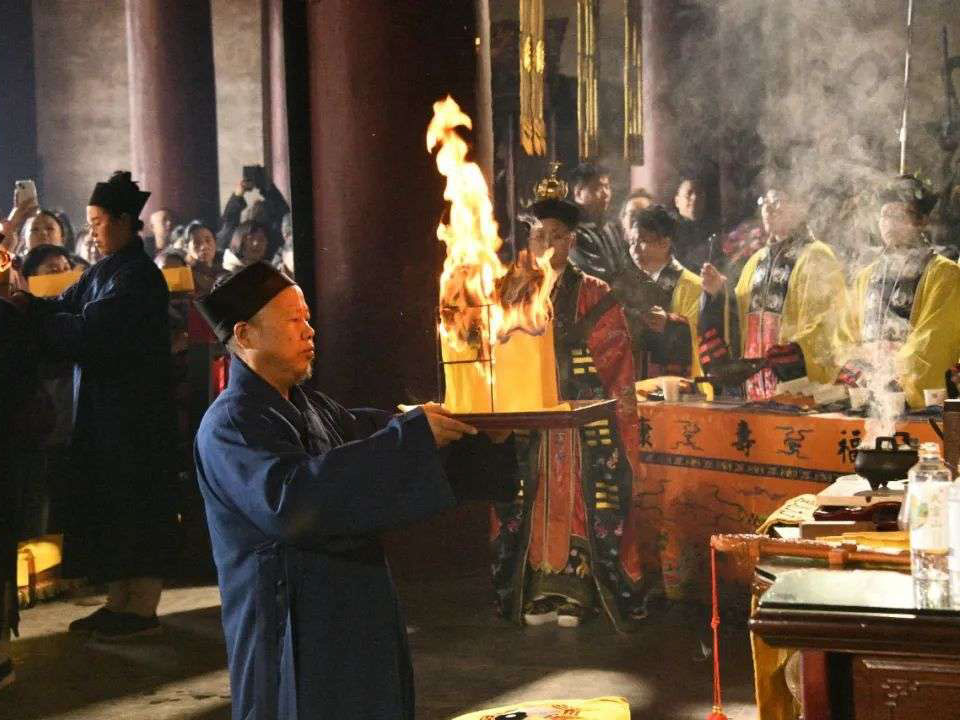
(1) The meaning of the ritual of fasting and Taoist ceremonies
2022-08-20 23:32:13
The original meaning of "zhai" was to be neat, harmonious an...
Yin GUI
2022-08-20 23:32:13
Chapter 27
2022-08-20 23:32:13
Chapter 72
2022-08-20 23:32:13
The couplet of the ancestral hall of the Wudang Mountain Temple
2022-08-20 23:32:13
Chapter 25
2022-08-20 23:32:13