


(II) Taoist Rituals
2022-08-20 23:32:13
Taoist rituals are the behavioral norms for Taoists in their daily lives. The difference between it and the precepts is that the precepts are clearly stipulated in articles, and those who violate them will be punished. Etiquette, on the other hand, is the most basic code of conduct for the Tao and the Earth. Those who violate it will be regarded as having bad character. It belongs to the part of Taoist rituals and norms. The content of Taoist rituals is very complex, ranging from daily greetings to large-scale activities such as going in and out and walking. Everything has certain etiquette. Meanwhile, the external etiquette and demeanor of a practitioner or adherent of the Tao also reflect their moral cultivation. Since its establishment, Taoism, while forming its own unique ritual image, has inherited some etiquette from Taoism and absorbed some of the rituals of Confucianism and traditional Chinese etiquette. In light of the actual situation of Taoism, it has standardized the external image of Taoists in many aspects such as clothing, food, housing, transportation, audio-visual, salutation, and altars. To distinguish them from the common people outside the world in terms of speech, clothing, comings and goings, diet, recitation and listening, and fasting, to restrain Taoists to cultivate the Tao with a pure mind and transcend the mundane world. Taoist rituals can be specifically divided into two aspects: "li" refers to etiquette, and "yi" refers to rituals. That is to say, Taoism is a kind of ritual that regulates Taoist behavior through its unique form of etiquette. It is a specific behavioral ritual distinct from that of ordinary people. Since its founding by Zhang Daoling, Taoism has developed a set of rituals, which have been continuously updated, improved and refined in subsequent dynasties. The establishment of the Quanzhen jungle system makes the requirements for etiquette particularly important. Taoism does not impose specific penalties on those who violate rituals; they are often dealt with according to the rules of integrity. (1) Etiquette regarding food and Accommodation In the past, Taoist monasteries and temples had strict norms for food and accommodation. When having meals on the road, one must follow the etiquette and go to the dining hall to eat, which is called "Guotang". There are three rules for those who live in the dining hall for meals: The first is the dining hall, where no etiquette is observed and one can eat freely, but one must be vegetarian and not speak wild words. The second is court attendance; The third step is to go through the lobby. Eating outside the dining hall is called "passing the dining hall". One should be neatly dressed and queue up outside the dining hall to enter and have meals. From the 15th day of the ninth lunar month to the 15th day of the third lunar month, it is customary to have meals at the dining hall. From the 25th day of the twelfth lunar month to the end of the lunch on the fifth day of the first lunar month, one must pass through the main hall. After passing through the main hall, the chief deacon put on the robes (also known as the Dharma robes) in the reception hall. The entire team, including the Hakka and lay leaders, stand solemnly in pairs at the entrance of the abbot (or inspect the abbot if there is a monk). The two envoys of the abbot (putting on the robes and holding the ruyi scepter) follow and stand on either side of the abbot. Bowing together, the guests and vegetarians led the group to the entrance of the dining hall and stood in groups behind the two rows of monks. When the Taoist priests heard the sound of the gong, they dressed neatly and lined up outside the entrance of the dining hall. The deacon lined up to invite the supervisor. The hall head, dressed neatly, went to ask for offerings. Two teachers of the scriptures, one to guard the offerings and the other to stand inside the hall. At the entrance of the hall, offer a small piece of rice, a small piece of clear water, a pair of chopsticks, light three incense sticks, burn one stick in the censer, and place the two sticks on the offering plate. Raise the offerings to the eyebrows, enter the hall, and offer them in front of the statue of the spiritual ancestor. Strike the clapper in accordance with Taoist rituals. When having meals, it is called "letting go of the meal". They do not "pass through the main hall". When they do pass through the main hall on a regular basis, the head of the hall "offers meals". After the "offering meal" is over, the attendants return to their seats and share the meal in the hall. It is strictly forbidden to "disturb the hall". When the people were having meals, they would walk around the hall to the left and right, and refill food and vegetables at any time. There are also regulations on the arrangement of bowls and chopsticks used in dining halls. Each person has two bowls in front of them. There are vegetables on the left side of the rice bowl. The horizontal chopsticks are close to the two bowls. If you want to add more rice, look at the dining hall with your eyes and point your chopsticks at the left bowl. "Wanting to add a bowl" means having a bowl. When the guests bring the rice and vegetable buckets to the front, they draw a circle in the bowl with chopsticks. The guests add rice and vegetables according to the circle drawn. When having a good meal, place the chopsticks straight between the two bowls to indicate that the fasting is over. When the hall head saw that all the people had finished their fast, he looked at the attendant and led the person down to his seat, Shouting, "Everyone, finish your fast." After the meal, the abbot, the supervisor and the Taoist monks bowed together and left one by one. When Taoists have meals, they must first offer sacrifices to the ancestral master. On the 28th day of the twelfth lunar month, a banquet was prepared in the guest hall. The fruit tea steward was invited to celebrate the New Year, and the Taoists were invited to have a meal and "Hun Yuan CAI". On the afternoon of New Year's Eve, an incense table was set up outside the mountain gate for the memorial tablets of the various schools of the Qianyu and Houhua sects. The abbot, senior officials and attendants went to the large kitchen to "receive the stove" and perform the birthday celebration ceremony. Then came the ceremony of receiving the auspicious god and stealing the auspicious money. From the first to the fifth day of the first lunar month; For the past five days, I have had "Hunyuan CAI" for lunch. Nowadays, in most palaces and temples, there is a separate ceremony called "passing through the small hall" for meals. The "passing through the hall" ceremony is rarely held. (2) Taoist Temple Rituals: Taoists in Taoist temples must live in the temple. The Zhengyi School requires that they maintain good Taoist etiquette and conduct within the temple and must not be mixed with the common people. Taoists and Taoist priests usually address each other as "friend" or "Taoist master", and for elderly Taoist masters, they are generally called "Mou Ye". The dormitory for Taoists must be clean and elegant, without any fancy decorations, but it should be tidy. Taoists are not allowed to lie naked, nor are they permitted to eat meat, drink alcohol or chat animatedly in the bedroom. No ordinary people are allowed to enter the Taoist dormitory at will, let alone stay overnight. The Qian Dao and Kun Dao are not allowed to live in the same courtyard. They should keep a distance from each other, have few desires and refrain from evil thoughts. One must not visit each other at will between the Qian Dao and the Kun Dao. After the morning meditation, one should immediately get up, wash up, go to each hall to pay homage to the patriarchs, attend the morning service, recite sutras and listen, and cultivate the mind. When staying at other temples, one must abide by the regulations of that temple. Without permission, one is not allowed to reside there permanently. (3) Wearing ceremonial costumes is a prominent feature of the religious form of Taoism, and people can clearly identify Taoists from their costumes. Taoists must wear scarves on their heads, Taoist robes, white socks and covered shoes in temples. The attire of Taoists was known in ancient times as "feathered clothes" or "feathered garments". The earliest unified customization of Taoist costumes began with Lu Xiujing during the Liu Song Dynasty of the Southern Dynasties. The clothing worn by modern Taoists, with both large and small jackets featuring "large collars", is a style of clothing of the Han people before the Ming Dynasty. Yellow with black border, for use when taking precepts; The "Dharma robe" refers to the robes worn by the "high priest" in a religious ceremony and the "abbot" during religious ceremonies. The flowered robe is the ritual dress worn by the Buddhist monks when they recite sutras in the hall or perform religious ceremonies. There are also plain ones without embroidery, commonly known as "banyi". The blue color is often used for the "da guan" and "Dao Shi" to symbolize the sky and the eastern green energy. The religious robes are mostly red and yellow, but there are also blue and green ones. The robes worn by the abbot are mostly purple. The class uniforms are mostly red and yellow. Taoism refers to the hats worn by Taoists as "jin", and there are nine types of jin. They are respectively: Hunyuan Scarf, Zhuangzi Scarf, Chunyang Scarf, Jiuliang Scarf, Haoran Scarf, Xiaoyao Scarf, Sanjiao Scarf, Yizi Scarf, and Taiyang Scarf. The qualified attire for a Taoist priest is not only to have neat clothes and hats, but also to be well-dressed. The so-called "crown" not only refers to a hat but also to specially made gifts and ornaments. The most commonly used ones include the Yellow Crown, the Five Great Mountains Crown, and the Five Elders Crown, etc. These are used during religious ceremonies and are exclusively for specific events, so they cannot be worn casually. There are also rules for the shoes and socks of Taoists. The most qualified shoes are double-faced ones made of blue cloth. Generally, they wear round-mouthed blue cloth shoes or "ten-directional shoes" with blue and white stripes. Multi-ear linen shoes are also acceptable. The socks are all high-heeled white cloth socks. The trouser legs of a Taoist must be tucked into the sock sleeve and must not be left open. If you do not wear high white socks, you must also tie your trouser legs up to your knees. If you don't tuck up your trouser legs when entering the temple, the temple master won't let you in. If you do enter the temple, you will be punished. Taoist priests are not allowed to wear a "crown" when using the toilet. Those who wear a "crown" when using the toilet will be punished. When performing inspection duties and imposing penalties, one must be neatly dressed and solemnly engaged in the work. (4) Rituals of the ritual of fasting and holding ceremonies: Fasting and holding ceremonies are compulsory courses in the daily life of Taoists. The rituals of a Taoist ritual are very complicated, such as offering incense, kowtowing, and holding a ceremony. When burning incense, one should also offer sacrifices to the gods. The offerings include incense, tea (water), lamps, flowers, fruits, etc. The Taoist priest held the offering with both hands in front of the offering table, raised it high to his forehead with both hands, bowed deeply, and then placed it on the offering table. The order of the offerings is from the inside out: tea, fruits, rice (rice products), vegetables (green vegetables, dried vegetables), steamed buns (flour products). You can also pour water and offer flowers to express your sincerity. When a Taoist priest offers incense, he first devoutly places three sticks of incense in the censer. Do not offer broken incense, nor unlit incense. If there is an open flame after being lit, it can be extinguished by swinging up and down. Do not use foul air to blow it out. After lighting the three incense sticks, he came to the front of the cushion, held the incense with both hands at the same level as his forehead, and bowed. Then stand in front of the incense burner and offer incense with your left hand. The distance between each incense stick should not exceed an inch. The order of offering incense is to start with the middle, then the left, followed by the incense. After offering the incense, one should return to the kneeling position, pay homage and kowtow. Taoist priests' kowtows are divided into two types: three kowtows and three kowtows, and three kowtows and nine kowtows. When bowing, the hands should not rise above the eyebrows or fall below the knees. The specific bowing method is as follows: Stand upright with your body held high, your eyes lowered, your mind calm, your feet about five inches away from the kneeling position, the distance between your heels about two inches, and the distance between your toes about eight inches, forming an outward "eight" shape. The salutation is as follows: Place both hands in front of the abdomen, with the thumb of the left hand pointing at the root of the ring finger of the right hand, the thumb of the right hand pinching the tip of the middle finger of the right hand, and the other four fingers of the left hand embracing the right hand. Bow and pay the salutation. When bowing, the hands should be level with the nose and not higher than the nose. Then, with the palm facing inward and the back of the palm facing outward, draw an arc and slide it down onto the chest. With the right hand, draw an arc and circle it downward to the right, while bending over. Kowtowing is as follows: Place the palm of your right hand facing down on the mat, leave your left hand in an arc from your chest to the left with a direction, and place it on the back of your right hand, overlapping with your right hand to form a cross. Kneel both knees on the mat simultaneously, with the forearms of both hands touching the mat at the same time. The tips of your elbows should be in a straight line with both knees, and then tap your head on the back of your hands. Raise your head, draw your left hand back to cover your heart, immediately draw your right hand back, and clench your hands as before. Stand up and stand still. This is the first bow and the first knock. After completing the three bows and three prostrations, step back half a step and prostrate again. Then, turn to the Taoist priest on duty at the same spot and bow once. At this point, the three bows and three prostrations are over. The Three Bows and Nine Kowtows are grand and solemn rituals in Taoism. On Taoist festivals such as the first, fifteenth day of the lunar month and the birthday of the patriarchs, when the abbot and the supervisor of the monastery perform the three major rituals and nine kowtows by offering incense and welcoming the deceased to the monastery. Taoists must participate in all kinds of Taoist activities, dress neatly and pray devoutly. No playfulness or laughter is allowed. One should perform with dignity. After becoming a monk or nun, one still needs to wear a "crown". The "crown cap" is the ceremony for a monk to officially become a Taoist. This kind of ceremony is only held in the Descendants' Temple. The crown scarf is also called "minor precepts". When performing the coronation ceremony, several masters are present, such as the coronation master (a highly accomplished master), the salvation master (also known as the mentor or master), the Hair gathering master, the introduction master or the salutation master, etc. The rituals of the Taoist ritual are very complex and also the most meticulous and important. When running a Taoist temple, one must treat it in accordance with Taoist conventions. On every new moon, full moon and major Taoist festival, in addition to paying homage to the ancestors, disciples also pay homage to their masters and students pay homage to their teachers. The Wu day is a Taoist death anniversary. People do not worship deities or offer incense on this day. According to ancient customs, it is advisable to close the temple and rest on the Wu day. (V) Etiquette for Leaving the House: One must not enter other temples or monasteries without reason, nor go to the homes of laypeople without reason. If you have something to do, go to a commoner's home. After finishing your business, return immediately and do not stay for long. One should not be impolite when coming or going near or far. Colleagues may be impolite and should not be ridiculed. (6) Speech Etiquette: When entering the Dharma hall or attending banquets, one should not speak loudly or cough loudly. One should not talk too much, should not argue with teachers or juniors, and should not point out others' faults. Let's not talk about mundane household chores. No words are used as a matchmaker. Do not whisper to a woman. When questioning and inquiring, pay homage during the worship service. If you ask about household matters, there is no need to worship. Don't talk about talismans, illusions or any other minor tricks with others. Taoism refers to all of the above as "purifying the mouth". (7) Work Etiquette: All work should not be called laborious. One should take good care of everything in the temple in daily life. When washing vegetables, cooking or doing other things, one should wash hands three times to remove all dirt. (8) Bathing Etiquette The bathing etiquette in Taoism is rather complex. Here are the main points briefly described. One should not take a bath with ordinary people and should not talk to others in the bathhouse. Bathing in the Micro-incantation Day: The universe opens up, the four great things are constant, water and impurities are dispelled, misfortune is dispelled, two children are protected, seven spirits are settled in the house, cloud and water are refined and nourished, all qi are mixed and healthy, internal and external are beneficial and upright, and the yellow robe is protected. (9) In the etiquette of washing hands and combs, the water used for rinsing and spitting should be led down slowly. One should not spit loudly. Dirty water should not be splashed onto others' clothes. It is prohibited to spit or gnash one's teeth in front of the deities in the Dharma hall. (10) Offerings Ceremony: The ritual of paying homage to the deities, such as: consecration of the deities, decoration of the temple, and offering of deities. Offering incense and the like all fall within the category of offerings. Since the Taoist ritual of worshipping deities begins along with the creation of deities, let's start with the creation of deities. (1) Statue creation: Statues of deities can be made in various forms such as wood carvings, clay sculptures, hollow art, and stone carvings. When sculpting deities, a ritual of worshipping the gods should be performed. There are mainly two ceremonies: ① Choose an auspicious time to hold the groundbreaking ceremony. First, offer sacrifices, burn incense, recite scriptures and pay homage. If it is a wood carving, the statue maker will use an axe to gently chop three or seven times above the wood to show the three requests or to bestow upon it the three souls and seven spirits. During the process of sculpting the deities, there must also be a "dirt-filling" ceremony. The purpose of this is to enable the deities to infuse themselves into the deities, making the deities truly become their subordinate spiritual bodies. If it is a wood carving, a hole is made behind the statue of the deity to reach the chest, and then an auspicious time is chosen to "install the dirt". The content of "pretending to be dirty" usually includes: classics, which represent deities and wisdom; The bronze mirror symbolizes that the deity can reflect the good and evil of the human world. Almanacs and grains symbolize that the deities can bestow favorable weather and abundant harvests. "Five grains in abundance;" Agarwood, cinnabar and realgar are believed to ward off evil spirits. Red, yellow. The five colored threads of blue, white and black correspond to the completeness of the five elements. Gold, silver and jewels symbolize that deities can bestow upon people wealth, honor and good fortune. Talismans and incense ash represent supernatural powers. (2) Consecration of the deity statue: After the deity statue is completed, the "consecration and eye-dotting" ceremony is held on an auspicious day. Prepare in advance cinnabar, bletilla striata, rooster, mirror, face towel, new writing brush and other items. At that time, offerings will be made, incense burned, sutras chanted, and mantras recited (chanting the "Golden Light Mantra", burning the altar, and reciting the sacred edits). The high priest will remove the red cloth from the statue, point the face of the statue with a new handkerchief, and then use a new brush dipped in a mixture of cinnabar, bletilla striata and golden rooster blood to dot the eyes of the statue (and also touch the mouth, nose and ears at the same time to indicate the opening of the orifice). At the same time, Outside the hall, a Taoist priest used a mirror to reflect sunlight into the eyes of the deity statue, symbolizing that the divine light of the sun enables the deity statue to perceive the human world. The "opening of the Eyes" ceremony is held with the aim of sincerely praying for the spirit of the deity to descend upon the earthly deity statue, making it a spirit body with the ability to communicate with the divine and inspire the spirit. The above are the daily etiquette of Taoists. In fact, the rituals of Taoism are rather complicated, such as audio-visual rituals, rituals for serving teachers, rituals for the human way, and rituals for observing precepts. Some of them have been described in the previous section on precepts, while others need to be modified with the changes of The Times to meet the requirements of Taoism in the new era.
One of the stars of the Big Dipper
2026-04-15 11:51:31
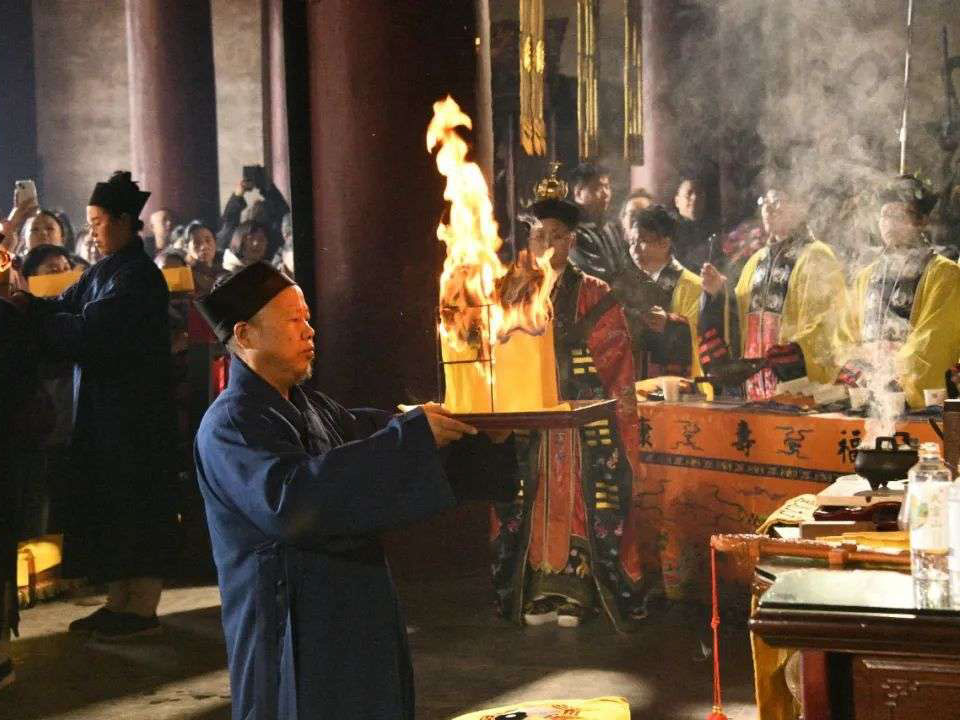
(1) The meaning of the ritual of fasting and Taoist ceremonies
2022-08-20 23:32:13
The original meaning of "zhai" was to be neat, harmonious an...
Yin GUI
2022-08-20 23:32:13
Chapter 27
2022-08-20 23:32:13
Chapter 72
2022-08-20 23:32:13
The couplet of the ancestral hall of the Wudang Mountain Temple
2022-08-20 23:32:13
The Wudang Taoist couplet congratulating the Rain
2022-08-20 23:32:13