


La Wanhui
2022-08-20 23:32:13
La Wanhui was from Chengguan, Jun County, Hubei Province (now Danjiangkou City). At the age of eight, he became a monk on Wudang Mountain and converted to the Hua Mountain School. He was able to recite the Four Books and the Five Classics before the age of ten, having advanced his Confucian studies before his descendants. At the age of eleven, he learned to play the pipe and the flute, and at twelve, he could practice rhymes in the morning and evening. At the age of fifteen, he became a Buddhist priest. At seventeen, he became a disciple of the Tianhe Tower in the Taihe Palace and learned the Zhengyi ritual. By the age of twenty, he had mastered all the Quanzhen Taoist rituals and Zhengyi rituals with ease. In 1933, he served as a high-ranking official at the Wudang Grand Taoist Temple and the Hanyang Xuanmiao Taoist Temple. In 1939, he returned to Wudang Mountain. Later, he left the temple and became a hermit Taoist priest. He lived in the area around the west River of Guanshan and set up a Taoist temple among the people. In 1956, relevant state departments excavated and sorted out the folk music of the Taoist capital. He accompanied the Taoist people in the temple to form a troupe and performed in Xiangyang, winning the first prize in the folk music performance organized by the Xiangyang Regional Cultural Bureau. In 1979, he returned to the Wudang Temple and assisted in organizing the Taoist music of Wudang. In July 1982, the Wudang Taoist Music Troupe was established. In August 1984, after the resumption of religious activities, he made significant contributions. Since June 1986, I have been providing materials for the recollection of "The Hubei Volume of the Collection of Chinese Ethnic and Folk Music". It took three years to finally assist in organizing and publishing the book "Taoist Music of Wudang Mountain, China". Master La devoted his life to Taoist music activities for eighty years. It is easy to imagine the efforts he made to the Taoist music of Wudang. Master La is straightforward, talkative and not fussy about minor details. His last method for spiritual cultivation was to let wine and meat wear through his intestines, and to refrain from it without restraint. The explanation is that becoming a monk or nun is a kind of faith, but if this faith is too mechanical or too formal, it actually goes against the original meaning of faith. For instance, La Daochang also ate meat, drank alcohol and smoked. This might stem from the unregulated rules of the Zhengyi School or perhaps it was a habit he had developed over the years. However, he said that this did not prevent his heart from following the Dao. The earth gives birth to all things, and all things nourish human beings. There is nothing to eat or not to eat; it's just that you should not be greedy. People with greed go astray. A person without greed is full of the spirit of the Tao everywhere. Perhaps it was precisely because of La Daochang's mundane yet refined beliefs and philosophy that during his many years of scattered residence, he established a very close relationship with the local people. In 1991, Daoist Master La Wanhui passed away at the Zixiao Palace in Wudang at the age of ninety.
One of the stars of the Big Dipper
2026-04-15 11:51:31
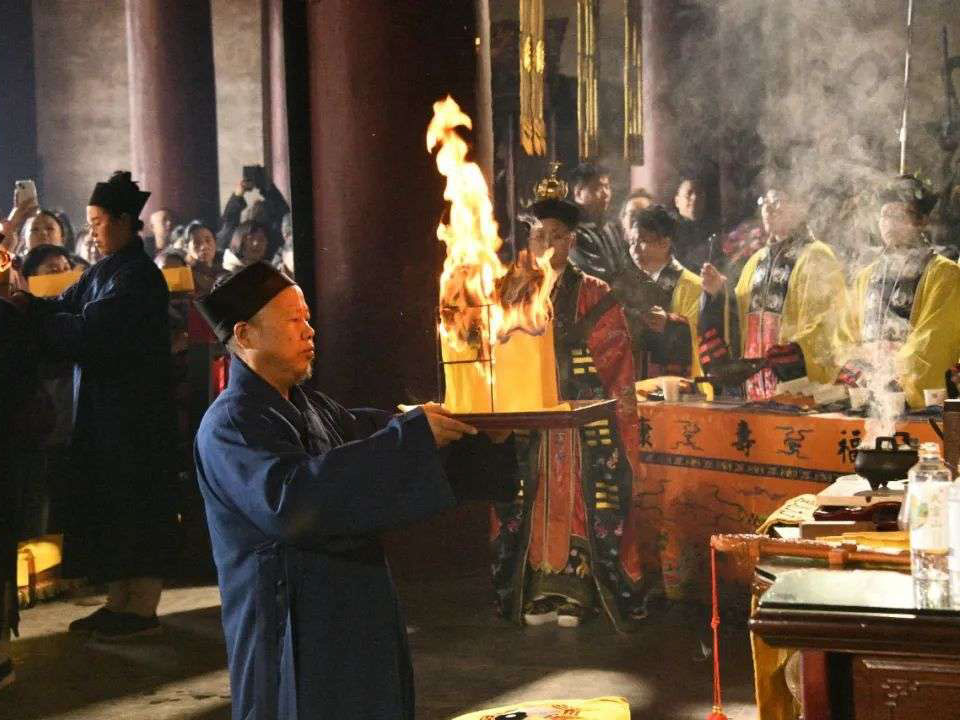
(1) The meaning of the ritual of fasting and Taoist ceremonies
2022-08-20 23:32:13
The original meaning of "zhai" was to be neat, harmonious an...
Yin GUI
2022-08-20 23:32:13
Chapter 27
2022-08-20 23:32:13
Chapter 72
2022-08-20 23:32:13
The couplet of the ancestral hall of the Wudang Mountain Temple
2022-08-20 23:32:13
Chapter 40
2022-08-20 23:32:13