


Fuji Monk
2022-08-20 23:32:13
Master Buer, whose given name was Yuanxin, was from Fangshan County, Beijing. He was a great cultivator of Wudang Mountain in the Ming Dynasty and a high-ranking Buddhist monk. According to the "Great Mountain Taihe Mountain Annals" of the Qing Dynasty, Master Bu 'er became a monk at Baiyun Mountain (now in the northern suburbs of Guangzhou City) during the Ming Dynasty and became a disciple of the eminent monk Dejing. In the 39th year of the Jiajing reign of the Ming Dynasty (1560 AD), he entered Wudang Mountain and resided at the Tiger Ear Rock, about ten miles northwest of the Nan Yan Palace, where he practiced for several decades. The Taoist name is Yuanzhen. It is recorded that "The advice of the virtuous scholars and officials came daily, the offerings of the imperial court came monthly, and the name of Tiger Ear Rock spread throughout the land." During the Ming Dynasty, due to the high reputation of the monk Buer, all the scholar-officials and scholars who came to pay homage to him were attracted by his fame. His residence was visited by a continuous stream of people every day. Moreover, the imperial court would bestow rewards upon him every month. During the Zhengde period of the Ming Dynasty, Master Bu 'er traveled among the common people to offer food. When Emperor Wu heard of his name, he bestowed upon him a thousand-Buddha robe. Master Houbu 'er returned to the mountain and passed away at Tiger Ear Rock. He passed away at the age of over 120. It is found that the "Great Mountain Taihe Mountain Annals" of the Qing Dynasty listed Master Bu 'er as a high-ranking monk of Wudang in the Qing Dynasty, which is actually inconsistent with historical facts. The reason for this might be that Master Bu Er was a monk and did not join the Wudang Taoist school, so it is mentioned later. According to the author's on-site investigation at the Tiger Ear Rock and the tomb of Master Buer around 1990, the situation is as follows: The Tiger Ear Rock is located in the mountains about ten miles northwest of the South Rock, with vast peaks and forests, far from human habitation. The rock faces south with its back to the north, directly overlooking the Tianzhu Peak of Wudang. The rock is a natural cave, wide and bright, indeed an ideal place for seclusion. I heard that several years ago, there was still Wang Daoren who had been fasting here for many years. Before that, there had been no one who had stopped practicing seclusion. There are still several small temples in the rock, but they are all in ruins. The tomb of the monk Bu Er is located on a ridge opposite the Tiger Ear Rock, about three li away from the rock. The tomb structure is grand. The tomb pagoda has five floors and is about 7 meters high. Stone arhats are carved around the pagoda. There are two lofty platforms in front of the pagoda, with elaborately carved stone incense burners and incense tables. The tomb covers an area of over mu (about 1,000 square meters). There were originally houses on both sides of the pagoda. The tomb is surrounded by tall brick and stone walls. From the bottom of the tomb to the top, one has to climb many stone steps, all of which have stone railings. Judging from the scale of the tomb, it is the largest among the existing tombs of Taoist priests in Wudang. There are currently two fallen memorial tablets in front of the tower, which are copied as follows: First, "The Record of the Construction of the Memorial Tablet by the Believers at Tiger Ear Rock". The names and surnames of the stele erected by believers from Henan, Shandong, Nanjing, Beijing, Beijing, Hubei, Zhejiang and other places. The date is unknown. The text on the back of the stele cannot be seen because the stele cannot be turned over. (Editor's Note) 2. "Inscription on the Stele for Sending Officials to Offer Sacrifices" Date: 1st day of the 7th Lunar Month of the 30th year of the Wanli reign of the Ming Dynasty, 3rd day of the Gengshen Lunar month, Ren Shu Yi Liang Text: The imperial commissioner of the Great Mount Taihe, concurrently in charge of the local affairs of the people in Hubei and Hunan provinces, was appointed as the supervisor of the rituals at the age of ○○○○. The chief priest was responsible for the main ceremony and guidance (planning and instruction). The officer Zhang Qianmei and Jia ○○ Yuan ○ are hereby appointed The incense and candles, as well as the paper offerings, were made in front of the memorial tablet of the Venerable Master No. 2 at Tiger Ear Rock. With a heart full of the fruits of the blue flower, I came to receive them and spread the spirit of universal salvation. I will visit every place. The Venerable Master has completed the cultivation in the rock valley and is now the supreme one who has temporarily abandoned the Saha world. The reputation of the Venerable Master is unbroken and cannot be fully appreciated. I have prepared a film and sent officials to offer the sacrifice. I can only express my deep feelings From "Inscription Two", it can be seen that the time of Master Bu Er's passing was in the 30th year of the Wanli reign of the Ming Dynasty, that is, in 1602 AD. It was during the Zhengde period of the Ming Dynasty, that is, between 1506 and 1521 AD, that the monk Bu Er traveled among the people in Zhengde to offer food. When "Emperor Wu" bestows a thousand Buddha robes, "Emperor Wu" should refer to Emperor Wu Zhu Yuanzhao. Master Bu Er entered Wudang Mountain in the 39th year of the Jiajing reign and passed away there in the 30th year of the Wanli reign, a period of forty-two years. From the early years of the Zhengde reign (1506 AD) to the thirtieth year of the Wanli reign (1602 AD), the social activities of Master Bu Er lasted for ninety-six years. According to the year 廾 when he became a monk, assuming he became a disciple at the age of ten, achieved success in his studies, and widely expounded the Dharma to benefit the world, his age would be approximately between thirty-five and forty years old. Then, the death of the monk Bu Er should have been after the age of 130. [Appendix] "From the South Rock to the North Rock to Pay Homage to the Venerable Master Bu Er" - Poem Ming: Wang Shizhen, though tired from ascending and descending, gazed at it to ease his mind. When the heart is at ease and the body is in harmony, strategies are drawn to explore the Taoist path. It was the early and late spring, with distant greenery gathering in the shade. A banner flutters in the air, and two trees sprout green in search. At first glance, it's a sheer cliff; at a leisurely pace, you'll catch a glimpse of the blue essence. The scholar Du Ji, 眄, could not be restrained. Sit on the lotus with me, and enjoy the birds of the forest. Clear and pure, like a flowing spring; Zeng Hong, like the sound of the sea tide. Suddenly, the view of the western mountain peak appeared, and the compass was already half submerged. Returning home, I am ashamed of the birds and fish; I am self-satisfied and forget my profound knowledge. Wang Shizhen (1526-1590 AD), whose courtesy name was Yuanmei and pseudonym was Fengzhou, was from Yaozhou Mountain (now Taicang, Jiangsu Province). A renowned literary figure of the Ming Dynasty and a leading general of the "Later Seven Scholars". The Wang family has a special affection for Wudang Mountain. According to the "Brief History of Taoism on Wudang Mountain", his father, Wang Yu, served as the governor of Hubei and Hunan in the 28th year of the Jiajing reign (1549 AD) and paid homage to Wudang Mountain, writing four seven-character regulated verse poems. In the fourth year of the Wanli reign (1576 AD), his younger brother Wang Shimao climbed Wudang Mountain and inscribed his father's poems on stone on the stone wall in front of the Liangyi Hall in the Nan Yan Palace. In the second year of the Wanli reign (1574 AD), Wang Shizhen was appointed as the deputy Censor of the Censorate and the commander of military affairs in Yunyang. The following March, he climbed Wudang Mountain and spent four days traveling there. During his nearly two years as the governor of Yunyang, he composed over 120 poems, odes, previews and records related to Wudang Mountain. In the poem "Encountering the Unrivaled Monk at Tiger's Ear Rock" by Yuan Hongdao, a slender face emerges from the secluded rock, with a delicate and exquisite appearance. For a hundred years, a room is locked in a wisp of smoke; the rocks by the stream and the frosty pines have changed several times. When Shi Yan was young, he lived in the Western Hills and once saw the beautiful scenery in the south. In the fourth month of the seventh year of Emperor Wu's reign, he put on his clothes and went to the Precept Altar Hall. Bai Tou died on a famous mountain, and for forty-three years, it was like a flash of electricity. Langmei weighed ten inches and saw her great-grandson's head as big as sleet. Deep in garment, I bend my fingers to greet the virtuous; the green mountains read people as if they were sent by mail. Yuanmei Bo Yu is no longer there. It's a pity that he was too smart to compile. Yuan Hongdao (1568-1610 AD), styled Zhonglang. From the public security Department of Hubei Province. He was the leading figure of the "Gong 'an School" (represented by the three brothers of the Yuan family) in the literary circle during the Wanli period of the Ming Dynasty. He was awarded the title of Jinshi in the Wanli reign and served as the magistrate of Wu County. In the thirtieth year of the Wanli reign (1602 AD), Yuan Shiyu accompanied his father Yuan Shiyu and his family to pay homage to Wudang Mountain and composed more than ten poems. His poem shows much disdain for the Taoist tradition of Bingshi Palace, but highly praises Taoist practitioners like Master Bu Er who practice fasting and seclusion in the same mouth. From Yuan Hongdao's poem visiting Master Buer, we can also verify several things about Master Buer: First, "Master said that when he was young, he lived on the Western Mountain", this Western Mountain might refer to Baiyun Mountain in the western suburbs of Guangzhou. Second, "The scenery of the South has been seen with one's own eyes." "The South" seems to refer to the residence of Wudang Mountain in "Jingnan", indicating that when Master Bu Er was practicing on Baiyun Mountain, he had already seen the inner vision or the Yang spirit traveling to understand Wudang Mountain. Thirdly, "When Bai Tou died on the famous mountain, it was like a stream of electricity for forty-three years" actually refers to the fact that Master Bu Er had been living on Wudang Mountain for forty-three years by the thirtieth year of the Wanli reign. So, if we trace back, the monk Bu Er came to Wudang Mountain in the 38th year of the Jiajing reign of the Ming Dynasty, not the 39th year. Fourth, Emperor Wu bestowed upon Master Bu Er the thousand-Buddha Robe in the seventh year of the Zhengde reign (1512 AD). Five, it has been proved that the rare tree species, the Chinese plum, does indeed exist in Wudang Mountain. Sixth, it should also be noted that after Yuan Hongdao's visit to Master Bu 'er this time, Master Bu 'er passed away on Wudang Mountain not long after. In the "Continuation of the Junzhou Annals, Volume 16, Miscellaneous Knowledge Chronicles", the writer (to be verified - the editor) recounted a strange event related to the monk Buer while recording the deeds of Huo Jingzhou. Huo Jingzhou was from Guizhou Province. As an afterword, I once went to Wudang Mountain with five fellow townspeople, Zhang Jinshi, Hu Xiaolian and Kunzhong, to offer incense. Hearing that Master Buer is in the mountains, one can know what will happen in the future. Then visit. Bu Er sat in meditation and entered a state of concentration, not daring to be startled, each waiting in silence beside them. After a short while, the master relaxed his eyes and saw all the gentlemen, asking them to sit down. After a long conversation, everyone sought instructions. The master held Huo Gong's hand and said, "Take your time. I'll see you off first." " When he reached the door, he saw his master's eyes brimming with tears and he exclaimed, "Poor!" Poor!" And goodbye. Then it was forwarded to Lord Huo. None of them understood the reason either. In the second year of Yue, An Chouchang rebelled in Guizhou Province and killed several people. Both Zhang and Hu are in a difficult situation. Huo Shi was appointed as the magistrate of Lin 'an, Zhejiang Province (Huo Jingzhou was appointed as the county magistrate of Lin 'an, Zhejiang Province at that time - Editor's note), and was exempted. Master Bu 'er knew this before. At that time, Xian in the mountains said that he was 120 years old in the second year of his reign. In the eighth month of the Year of the Tiger, I was at the Tongde Mountain Chan Temple in Wuling. There was an old monk who said that he was no different disciples and was already over a hundred years old. Xun Bu 'er was already in the year of Yi Chou. Note from "Zhongnan Jiwen" : The "Yi Chou" recorded in the text occurred in the 44th year of the Jiajing reign (1565 AD) and the 5th year of the Tianqi reign (1625 AD). There was no "Yi Chou" in the Wanli reign, indicating that Master Bu Er's "Yi Chou" was not accurate. The year "Bingyin" refers to the 45th year of the Jiajing reign. The old monk said that his teacher passed away in the year of Yi Chou, that is, the previous year. It is possible that this was done to deceive and hide the question.
One of the stars of the Big Dipper
2026-04-15 11:51:31
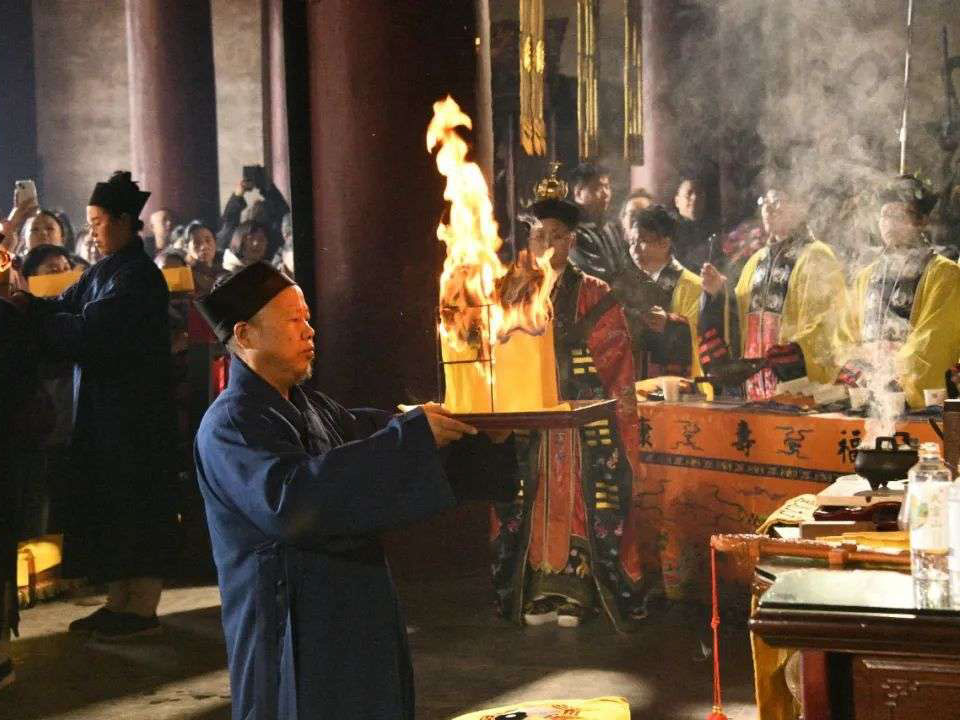
(1) The meaning of the ritual of fasting and Taoist ceremonies
2022-08-20 23:32:13
The original meaning of "zhai" was to be neat, harmonious an...
Yin GUI
2022-08-20 23:32:13
Chapter 27
2022-08-20 23:32:13
Chapter 72
2022-08-20 23:32:13
The couplet of the ancestral hall of the Wudang Mountain Temple
2022-08-20 23:32:13
Chapter 40
2022-08-20 23:32:13