


Ten Key Points of Tai Chi Chuan
2022-08-20 23:32:13
(1) The principle is that when things are scattered, they must be unified; when they are divided, they must be united. In the universe, in all directions, what is bustling and chaotic each has its own place. Among the countless threads, the hustle and bustle always has its source. One book can be scattered into ten thousand essentials, and all the essentials can be consolidated into one book. The study of martial arts is no exception to this rule. Tai Chi practitioners are ever-changing and ever-exerting force. Although the postures may vary, the force is unified. The so-called unity, from the top of the head to the feet, has internal organs, tendons and bones, and external skin and flesh. All the limbs and bones are connected as one. To break through but not open, to collide but not disperse, when the upper desires to move, the lower will follow; when the lower desires to move, the upper will lead; when the upper and lower move, the middle responds; when the middle moves, the upper and lower unite. The inside and outside are connected, and the front and back need each other. What is called a consistent process is called 欤! Rather than forcing it, one should follow suit and do it. It moves at the moment, like a dragon or a tiger, and strikes unexpectedly, as swift as a flash of lightning. At that moment, it was still, serene and clear, standing firm like a mountain. There is no stillness at all, and there is no sense of unevenness or concern inside or outside, above or below. It moves without any movement, with no pulling or shifting in front, back, left or right. It is truly like water flowing down, surging and impossible to control. If a lighter strikes from within but fails to cover one's ears. Without hesitation to think, without being bothered to propose, it has come to fruition unexpectedly. Strength accumulates over time and becomes beneficial, and effort is achieved through long-term practice. Observing the consistent learning of the sages, one must learn widely, have a strong understanding, and investigate things to gain knowledge before achieving success. It is known that there is no difficulty or ease in things; effort can only progress on its own. One must not 躐等 or rush. One should proceed step by step in an orderly manner, gradually advancing. Then, all the bones and tendons will naturally connect, and it will not be difficult to connect the upper and lower, the exterior and the interior. Thus, the scattered will be unified, the divided will be combined, and all the limbs and bones will eventually converge into one qi. (2) In the universe, there is no such thing as going straight without returning, nor is there always something straight without being curved. All things should be treated properly and all forces should be returned. This is an unchanging principle throughout history. There are often people in the world who discuss the pounding of qi and also those who discuss it. If qi governs one, how can it be divided into two? The so-called two are breathing, and breathing is Yin and Yang. The pounding must not be without movement, and the breathing must not be without breathing. Exhalation is Yang, inhalation is Yin. Ascending is Yang and descending is Yin. When Yang energy rises, it becomes Yang; when Yang energy descends, it becomes Yin. When Yin energy rises, it becomes Yang; when Yin energy descends, it remains Yin. This is the reason why Yin and Yang are divided. What is meant by clarity and turbidity? What rises upwards is clear, and what descends downwards is turbid. The clear is Yang, and the turbid is Yin. However, when discussed separately, they are Yin and Yang; when discussed collectively, they are qi. Qi cannot be without Yin and Yang. That is to say, a person cannot be without movement and stillness, the nose cannot be without breathing, and the mouth cannot be without entry and exit. This is why it is the principle of treatment and return. However, the qi is divided into two but converges into one. Those who are determined to follow this path should not be confined by it. (3) The three sections of qi originate from the body, and the body has many sections. If we discuss each section one by one, it would go far beyond the purpose of boxing. Only by dividing them into three sections can we obtain the method of division: the upper, middle, and lower sections, or the root, middle, and tip. In terms of the entire body, the head is the upper section, the chest is the middle section, and the legs are the lower section. In terms of the head and face, the forehead is the upper section, the nose is the middle section, and the mouth is the lower section. In terms of the middle body, the chest is the upper section, the abdomen is the middle section, and the dantian is the lower section. In terms of legs, the bladder is the root joint, the knee is the middle joint, and the foot is the tip joint. In terms of arms, the shoulder is the root joint, the elbow is the middle joint, and the hand is the tip joint. In terms of hands, the wrist is the root joint, the palm is the middle joint, and the fingers are the tip joints. From this perspective, there is no need to elaborate further. However, from the top to the bottom, each has three sections. To put it simply, if there are no three sections, there will be no place to focus. For the upper section is unclear, without support or origin, the middle section is unclear, the mind is empty, and the lower section is unclear, subversion is bound to occur. From this perspective, how could the three sections of the body be neglected? As for the activation of qi, it should start from the distal nodes, follow the middle nodes, and be spurred by the root nodes. To put it specifically; If all are put together, from the top of the head to the soles of the feet, all the limbs and bones form one section. Then, why is there three sections? How could it be that there are three sections in each of the three? (4) The Four Tips should be discussed beyond the body itself. The four extremities are the remaining threads of the body. Those who talk about the body are not good at this at first, and those who talk about qi are also rarely heard of. However, it is said that qi originates from the inside and spreads outward. Qi originates from the body and reaches the tips of the hair. If qi is not derived from the body, it will be empty and not substantial. If one does not reach the tip, it will be solid but still empty. It's beyond words! If fingers and feet are the tips of the ears of the body! And it has not even reached the tip of the tip. What are the four tips? The origin of the hair is not listed among the five elements and has nothing to do with the four bodies. It seems there is no point in discussing it. However, hair is the tip of blood and blood is the sea of qi. Even if qi is not derived from hair, it must not be separated from blood to generate qi. If there is no separation from the blood, one must also pay attention to the hair. When the hair is about to reach the crown, the blood at the tip is sufficient. The tongue is the tip of the flesh, and the flesh is the sac of qi. If qi cannot reach the tip of the flesh, it cannot fill its volume. Therefore, the tongue must want to push the teeth, but the tip of the flesh is sufficient. As for the bone tips, they are teeth. The tendons and tips are the nails. Qi originates from the bones and is connected to the tendons. If it does not reach the teeth, it will not reach the tips of the bones. If the nails do not reach the tips of the tendons and the nails do not penetrate the bones, it is impossible for the teeth to reach the tendons and the nails to penetrate the bones. If that's the case, then four tips would be enough. With four feet, the qi is self-sufficient. How could there be the drawback of being empty but not full, and full but still empty? (5) The five internal organs are used to describe the momentum, and the momentum is used to describe the qi. A person takes shape from the five internal organs, that is, the qi comes from the five internal organs. The five internal organs are actually the source of life and the origin of qi, and are thus called the heart, liver, spleen, lungs and kidneys. The heart belongs to fire and thus shows signs of inflammation. The liver belongs to wood and thus has a curved or straight shape. The spleen belongs to the earth element and thus has a kind and generous nature. The lung belongs to metal and thus has the ability to transform. The kidney belongs to water and has the function of moistening the lower body. This is the meaning of the five internal organs and is in harmony with the qi, all of which are matched accordingly. All those who teach martial arts in this world must not deviate from this. It lies within. The chest and diaphragm are the positions of the lung meridian and serve as the canopy for all the internal organs. Therefore, when the lung meridian moves, all the internal organs cannot remain still. The heart is located between the two breasts, and the lungs protect it. Below the lungs and above the diaphragm, it is the position of the Heart Meridian. The heart is the ruler. When the heart fire stirs, all the other flames follow suit. Below the breasts, the right side is the liver and the left side is the spleen. The fourteen joints on the back are the kidneys. As for the waist, it is the base of the two kidneys, the first of the innate constitution, and also the source of all internal organs. Therefore, when the kidneys are strong, the elements of metal, wood, water, fire and earth all display their vitality. This is about the parts of the five internal organs. However, the five internal organs that are located within each have their own positions, and those that are reflected in the body also have their own specific roles. But their positions are numerous and difficult to describe all. Generally speaking, the protruding parts of the body belong to the heart, the sunken parts to the lungs, the exposed parts of the bones to the kidneys, the connected parts of the tendons to the liver, and the thick parts of the flesh to the spleen. To understand this, the heart is like a tiger, the liver is like an arrow, the power of the spleen is boundless, the position of the lung meridian is the most flexible, and the movement of the kidney qi is as fast as the wind. This is the experience of those who are in the situation. It is not something that can be fully exhausted by words. (6) Once the five internal organs are clear, let's talk about the three harmonies. The so-called three harmonies refer to the harmony of the heart and the mind, the harmony of qi and the harmony of strength, and the harmony of sinews and bones, which are the internal three harmonies. When the hands and feet are in harmony, the elbows and knees are in harmony, and the shoulders and hips are in harmony, the three are in harmony. If the left hand is brought together with the right foot, the left elbow with the right knee, the left shoulder with the right hip, and the right with the left, the same applies. And when the head is in harmony with the hands, the hands with the body, and the body with the steps, which one is not an external harmony? When the heart and eyes are in harmony, the liver and tendons are in harmony, the spleen and flesh are in harmony, the lungs and body are in harmony, and the kidneys and bones are in harmony, which is not internal harmony? However, this is particularly convenient to put it simply. In conclusion, when one moves, nothing moves; when one unites, nothing unites. All the internal organs and bones are contained within. (7) Even if one knows the three combinations, there are still six combinations. What are the six stages? The head is the foremost of the six Yang energies and the master of the entire body. All the five senses and bones reflect this orientation. Therefore, the head must move forward. The hand is the vanguard, and the foundation lies in the shoulder. If the shoulder does not advance, the hand will not move forward. Even the shoulder must be taken in. The qi gathers in the middle of the abdomen, and the mechanism is in the waist. If the waist does not advance, one will be discouraged and not feel solid. This is why the waist is valued more than the progress. The mind permeates the entire body, and movement lies in the steps. If the steps do not advance, the mind will be completely unable to act. This is why the steps must be advanced. And if you go up to the left, you must go up to the right. Going up to the right will always lead to the left. There are six steps in total. Among these six steps, which one is not a place that requires force? In short, if it is not advanced in a timely manner, there is no sense of agility throughout the body. If it is advanced in a single word, there is no form of distraction in the entire body. This is the way of the six advancements. (8) Body Techniques: When a man strikes an enemy with his hands, it all depends on the assistance of body techniques. How can body techniques be maintained? It's just about vertical, horizontal, high, low, advancing, retreating, reversing and sideways. If they go unrestrained, they will release their momentum and never return. When it is horizontal, it should manage its force; it should be open and unobstructed. To be tall means to lift one's body, and the body implies growth. When the body is low, it restrains itself, and the body has a form of restraint. When it's time to move forward, forge ahead with all your might and courage. When it is time to retreat, retreat quickly and turn back to subdue the position. As for looking back, the back is the front. Looking sideways to the left and right, how dare they take my place? Rather, it should be done without being bound by any restrictions. To assess the strength of one's wife depends on one's own approach, which can be either vertical or horizontal. The vertical and horizontal aspects change according to the situation and cannot be generalized. There are ups and downs, and the highs and lows can change at any time. How can they be judged in a uniform way? Sometimes, one should advance rather than retreat; retreating will discourage one's spirit. When it is appropriate to retreat, do so; retreat to encourage progress. To advance is to advance, and to retreat is to assist in advancing. If one turns around and looks behind, one will not realize that one is behind. Looking sideways to the left and right, yet not realizing that they are left and right. In conclusion, what is observed is in the eyes, what changes are in the heart, and what is grasped is inherent in the body. When one steps forward, the four bodies will move without being bound by fate. When the body is timid, all the bones will be at ease. The body movements can be set aside but not discussed. (9) Footwork: Today, all the limbs and bones are in motion, and the actual movement is through steps. The step is the foundation of the body and the hub of movement. Therefore, when facing the enemy in battle, one must be true to oneself. And therefore, the pillar of one's life is none other than walking. Adapting to circumstances lies in the hand, and what is the shift of the hand also lies in the step. Advancing and retreating in reverse and sideways, without steps, how could there be the opportunity to stir and beat? Rising and falling, stretching and contracting, without steps, how could there be the beauty of change? It is said that observation is in the eyes, change is in the heart, and transformation is in the corners, ever-changing, without reaching a state of distress. Could it not be that the step is in charge of fate 欤? And it cannot be achieved by force. Actions come without intention, encouragement comes without awareness. When the body is about to move but the steps are already in motion, and the hands are about to move but the steps are already urged, they come unexpectedly and are already there. There is no need to drive them but they seem to be driven. What is meant by "when the upper body wants to move but the lower body follows suit" is 欤? And if a step is divided into front and back, and there is a positioning, it is called a step. Those without a clear position are just walking. Just as one step forward, the next step follows suit, with each having its own position. If the previous step becomes the next step and the next step becomes the previous step, or if the previous step becomes the next step and the next step becomes the previous step and the next step, there will be no positioning between the front and the back. In conclusion: The act of pounding is used to determine the momentum, while grasping the key is the step. Whether one lives or not lies in one's steps, and whether one is agile or not also lies in one's steps. How useful it is to take a step! (10) The application of hardness and softness in boxing is merely about qi and posture. However, qi has its strength and weakness, and power can be divided into hardness and softness. The strong qi takes advantage of the hardness of the power, while the weak qi takes advantage of the softness. Hardness can control a hundred pounds with a thousand pounds of force, while softness can break through a thousand pounds with a hundred pounds of force. The distinction between hardness and softness lies in the combination of strength and ingenuity. However, when hardness and softness are separated, their functions and effects are also distinct. When the limbs are activated, the qi flows outwardly, while the interior remains still and heavy, which is a manifestation of hardness and strength. When qi is stored within, it manifests externally as lightness, harmony and softness. Firmness cannot be without softness; without softness, the encirclement will not move fast. When softness is used, it cannot be without hardness; without hardness, pressure cannot be exerted smoothly. When hardness and softness are combined, they will stick, swim, connect, follow, soar, flash, fold, empty, 掤, smooth, squeeze, and hold. There is nothing that cannot be avoided naturally. Firmness and softness should not be used interchangeably; how can one neglect the use of martial arts?
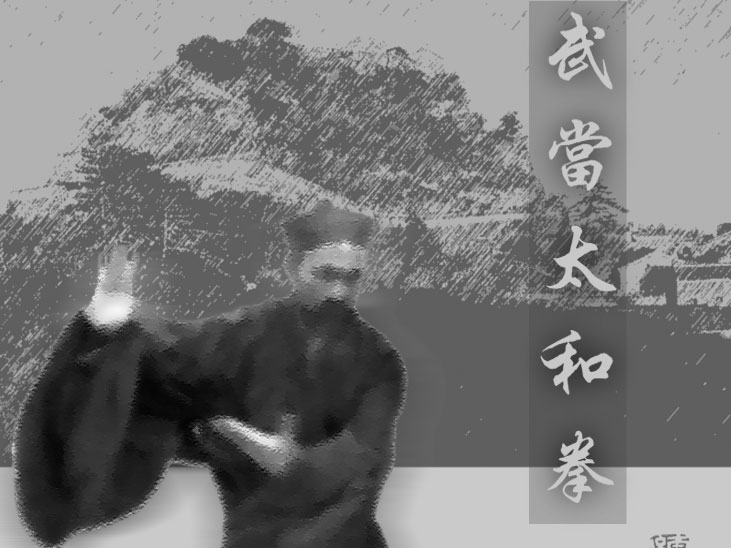
Wudang Divine Skill: Two-Finger Zen
2022-08-20 23:32:13
Taiqing in the Liangyi Hall of Nan Yan Palace
Verified by Zhang Sanfeng with the same name and pronunciation
2022-08-20 23:32:13
The main hall of Taizi Rock
Wudang snake-shaped sword
2022-08-20 23:32:13
The Jade Maiden of the Wansheng Pavilion in Taihe Palace
The hand of Yu Yu from the Dan Gong Sect
2022-08-20 23:32:13
Zhao Caishen in the Wansheng Pavilion of Taihe Palace
Zhang Sanfeng's original style Tai Chi
2022-08-20 23:32:13
Zhenwu of the Wansheng Pavilion in Taihe Palace