


Wuxing Tongbei Quan
2022-08-20 23:32:13
Five Elements Tongbei Quan, also known as "Tongbei Quan", "Tongbei Quan" or "Tongbei Zhang", was ancient-called "Tongbei Gate", and later also referred to as "Bai Yuan Gate" and "Tongbei Yuan Gate". The techniques of Wuxing Tongbei Quan mainly draw inspiration from the movements of the gibbon. The fist moves with palm techniques as the core, and the basic palm techniques and force of the Five elements of palm - throwing, slapping, piercing, splitting, and assembly (corresponding to metal, wood, water, fire, and earth) - are the main body of the fist techniques, hence its name. Nowadays, there are many contents of Tongbi Quan that have been passed down. The main ones include Wuxing Tongbei Quan, Lunzhou Tongbi Quan, Bai Yuan Tongbi Quan, Mantis Tongbi Quan, Sha Shi Tongbi Quan = Shaolin Tongbi Quan, Hongtong Tongbi Quan, Tongbei Quan, etc. Although the names are similar, their styles, characteristics and techniques are not exactly the same, but their principles are consistent. This article does not cover all of them. It only focuses on introducing the Five Elements Tongbei Quan (referred to as "Tongbei Quan" for short). The emergence of Tongbi Quan is said to date back to the Warring States Period, which is over two thousand years ago. However, there are no conclusive historical records about its detailed history, origin and primitive techniques, and thus the legend cannot be trusted. According to the remaining written records in the boxing manual, the earliest transmission of the Tongbi Quan was approximately during the Yongzheng to Daoguang periods of the Qing Dynasty, when Mr. Qi Taichang from Zhejiang first taught this boxing style. In subsequent generations, there were successors. By the end of the Qing Dynasty and the beginning of the Republic of China, this art had flourished greatly, with many skilled practitioners emerging. The name of Tongbei Quan became even more renowned throughout the world. The Tongbi Quan has been around for about two hundred years since its introduction. During this long period, there have been inheritances, omissions, developments, and innovations. At the same time, many figures who carried on the legacy and opened up the future have emerged, such as the earlier Mr. Chen Qing and the later Mr. Li Qinghai, Mr. Wang Zhanchun, and Mr. Xu Tianhe. Later on, there were many masters with the same arm, such as Liu Guangxing, Liu Zhi, Xiu Swordsman, Zhang Ce, Zhang Ji, Liu Yueting, Xu Rang, etc. Later on, there were also renowned scholars like Yao Baoqi and Liu Xianwu both at home and abroad. At present, the masters of Tongbei Quan who are renowned both at home and abroad include Wang Zhihe from Guizhou, Sha Guozheng from Yunnan, Wang Xialin from Beijing, Deng Hong from Tianjin, Xue Yiheng from Shenyang and Han Junyuan from Lunzhou. Among the middle-aged and young people, there are Yuan Qiqiang, Liu Yunfa, Lin Xinhai, Hu Baolin, Yang Jiansheng and so on. Some of them are good at inheriting and carrying forward traditions, and some have achieved excellent results in national martial arts competitions many times. For a relatively long period of time before the 1950s, those who were not well-versed in Tongbei Quan cherished it and kept their techniques secret, reluctant to teach it to others easily. Due to various social reasons of that era, Tongbi Quan almost vanished and was lost. Although there are occasional transmissions, they are mostly secret teachings from relatives and friends, and the selection of disciples is extremely strict. As for textual illustrations, they are nowhere to be seen. At that time, the transmission areas included Hebei, Henan, Shandong, Liaoning, Beijing and Tianjin, among others. It is only in recent years, with the vigorous promotion of the state, the exploration of traditions, the organization and inheritance, and the exchange and promotion, that Tongbi Quan has begun to be active in China's martial arts circle and has achieved certain development. First, Tongbi Quan is a pictographic and ideographic martial art. In nature, the reason why many wild animals can survive lies in the fact that each of them has its unique skills. That is, survival skills and guard hunting skills. The former is a way of life, while the latter is a skill relied upon for hunting food and forced self-defense battles. For human beings, it is the techniques of health preservation and martial arts. The "Tongbei Quan" is inspired by a pictographic form, and its model is the Tongbei ape. It is named so because its forelimbs (arms) are particularly long. According to the traditional interpretation, "tong" means to connect and string together, metaphorically referring to the fact that the two arms of a gibbon can connect left and right, stretching and shortening at will. In fact, this is not the case. It is an exaggerated statement. It is just that the arms (forelimbs) of the gibbons were particularly long, strong, powerful, flexible and agile. The characteristics of the gibbon are: it is good at climbing, fast and agile, capable of climbing high and dangerous places, climbing vines and leaping through forests, being agile and light, and advancing through the autumn sky like a flying bird. Sometimes, people stand and walk on the ground, staggering and wobbling forward. In the fight, the movement (claw) is swift and rapid, and the leap has reached its peak. When quiet, one can hold onto the essence and remain steadfast, as peaceful as a wooden rooster. When playing and having fun, they are lively and ingenious, with countless techniques. People imitated the movements of the long-armed ape and mastered its unique skills. After processing, they summarized a set of boxing techniques that incorporated imagery and meaning, which is today's long-armed boxing style. Ii. The Movement Characteristics of Tongbi Quan The movement characteristics of Tongbi Quan are numerous, with different styles and objects. The main points are as follows: 1. Combining form and spirit, integrating the six methods. The movement of Tongbi Quan is inspired by both the external and internal images of the gibbon, and the two are unified. Its technique is not merely a simple imitation of the original, but rather it takes the essence and imitates the supernatural, achieving a "spiritual resemblance". Therefore, when performing the Tongbei Quan exercise, one should twist the waist and cut the hips, inhale and exhale the chest and back, exert force from the waist and back, swing the arms and shake the wrists, keep the arms as sharp as whips, extend and strike far, be flexible and fast, have both body and function, and possess both form and spirit. The movements of the through-arm Fist are coordinated, integrating the six methods. The so-called six methods refer to the internal three methods and the external three methods. Unity means coordinated and unison movements. The Three Internal methods are the coordination and consistency of the three aspects of mind, qi and force. That is, when exercising, one's mind is concentrated, breathing is smooth, and the force is applied in a uniform and coordinated manner. The "Three Outer Techniques" refer to manual techniques, body techniques and footwork techniques, that is, when performing movements, the posture is coordinated and unified, balanced and steady. In this way, the internal and external aspects are in harmony, and the six phenomena become one. 2. Natural cleansing and dyeing, the soul is ever-changing. When performing the arm fist movement, the face does not take on the shape of an ape but is naturally lively, simple yet bold. All the joints of the body are loose and flexible, soft yet firm. The posture is light and agile, shrunken, small, soft, flexible and ingenious. The response is sensitive, stretching, spreading, fast, long and lively. High and low, left and right, long and short, slow and fast, opening and closing, virtual and real, up and down, movement and stop. What is more important is to be restrained and adaptable, to be moved by the scene, to be flexible and flexible, and to be flexible and changeable. 3. Light and agile, rapid and intense arm-piercing fist movements, like the spirit of an ape, the dexterity of a cat, the momentum of a tiger, the might of a lion, hands like shooting stars, movements like snakes, like explosive flames, like bullets hitting the target. The force is exerted in an instant, and the explosive power is very strong. Its leaping, bouncing, jumping and leaping are light, agile and swift. Flash, spread, leap, correct 猱 vigorous; Forward, backward, turn, spin, as fast as electricity. The movements of the through-arm Fist are soft yet intense, fast yet vigorous, easy yet tenacious, powerful yet vigorous, beautiful and dexterous, with a relatively large amount of exercise. 4. The momentum is smooth and continuous. The backswing is like a burst, with the arms and fists extended and generous, with a smooth and continuous momentum. His punches rise and fall alternately, with continuous force, breaking and then reconnecting. The two hands are like a string of beads, swinging, circling, linking, turning and carrying the rings, as if the rings were missing, like the flowing rivers. During the movement, when the hands interweave with the wrists, forearms, shoulders, hips, body and other parts, rubbing, tapping and patting, the sound is crisp and loud, like a crackling whip. 5. The force is full and the combat effectiveness is strong. The force application of the through-arm fist emphasizes the twenty key words: cold, springy, crisp, fast and hard, deep, long, soft, gentle and ingenious, as well as the application of many techniques, such as throwing, slapping, piercing, splitting, drilling, tricky, grasping, locking, knocking, shuthering, hugging, leading, 攉, shaking, lifting, breaking, pressing, hanging, fanning, pounding, etc. When exerting force, the point of application is clear, the strike point is accurate, the internal and external aspects are integrated, and the force is full and vigorous. When in motion, follow the natural course, emphasize practicality, and every move is a technique. Every move is for practical use, and the combat nature is very strong. The movement characteristics of the Tongbi Quan are described in the boxing manual as: "The techniques and momentum are like shooting stars." The body movements are like lightning. The footwork and movement are as swift as flying." And "The pipa bone is as lively as a fan, and the two hands connected like a string of stars." "Body like a bow, hands like arrows, waist like a snake, feet like drills" and so on, can very briefly and accurately describe the style and characteristics of the Tongbei Quan movement. Iii. Main Contents and Technical Essentials of Tongbi Quan Today, Tongbi Quan has a very rich content and has formed several schools. Although there are few differences in tradition, the styles and techniques are similar (or have slight similarities and differences), and the principles are the same. The content of Tongbi Quan consists of two aspects: boxing techniques and weapons. In terms of boxing, there are various postures, manipulation techniques (training methods for different parts such as hands, arms, legs, waist and body) and routines. Different schools have different routines. The traditional main routines include Tongbei Liuhe Quan, Daxiao Lianhuan Quan, Lianhuan Pao, Tongbei Disassembling Quan, Lianhuan Splitting Mountain Pao, Tongbei Stringing Beads Zongshou, etc. In terms of development content, it is also quite rich. For instance, my teacher, Mr. Sha Guozheng, was taught by two masters of Tongbei Quan, Liu Guangxing from Shandong and the sword enthusiast from Yanbei, during his youth. With over sixty years of practical training, he has gathered the skills of various schools and created the basic techniques for beginners to learn Tongbei Quan. Seventy-two basic palm techniques and six sets of full-arm beading "Grapes Full Rack" (each set has six to eight movements and over sixty movement units). Among them, several events have won excellence awards in several national martial arts competitions, and some have been used as overseas performance events and received high praise. In terms of the arm-piercing fist series of weapons, there are sticks, single swords, double swords, large spears, flower spears, single swords, double swords, etc. The technical essentials of the Tongbei Quan movement are extensive in content and strict in requirements. There are many theories and techniques (practice methods and application methods). Generally speaking, there are the following aspects. In terms of physical training, the main technique is the three folds and nine key points. That is, the wrist, elbow and shoulder are folded forward. This is a technique that makes the arm soft and flexible, soft yet firm. When used, it is as supple as a whip and as powerful as a shooting star. Bending the chest, back and waist in the middle is a body technique. One should have a clear mind and a refreshing spirit, breathe naturally, let the qi sink to the dantian, be lively and flexible, and move like lightning. Fold back into the hips, knees and feet, the footwork, and train the lower body to be light and agile, with movements as swift as flying. In terms of basic boxing techniques, the main ones are the five punches of throwing, slapping, piercing, splitting and drilling. Its technique is: the palm is thrown like lightning, the force is exerted on the wrist, and it includes throwing, thrusting, shaking and exploding. The clapping is like a mist, with the force exerted on the shoulders, encompassing the techniques of patting, folding, crushing and rubbing. The palm is like a string of stars, the force is exerted on the hips, and it contains chopping, embracing, dropping and pounding. The palm pierces like an arrow, and the force is exerted at the waist, containing the functions of splitting, flicking, squeezing and pressing. The basic techniques of the other forms of boxing and weapons are quite extensive and all have similar technical essentials. In terms of manipulation techniques, there are requirements such as stretching, probing, poisoning, pushing, closing, relaxing, straightening, twisting, bending, following, and pushing. There is a lot of content in terms of usage, mainly the techniques of "Five Gains" and "Eight Judgments". The five gains are top, bottom, left, right and middle. The Eight judgments are movement, stillness, emptiness, fullness, hardness, softness, slowness, and haste, etc. The key points of the Tongbei Quan movement, as mentioned above, mainly lie in the combination of spirit and form, being natural and lively, having a continuous flow of momentum, being vigorous and light, stretching and striking short, with full force and unique style. In conclusion, there are certain strict requirements for the hand, eye, body, method, step, mind, qi, force, technique and application of the Tongbi Quan, as well as the acquisition of data in attack and defense, and the integration of hardness, softness, emptiness and reality to facilitate restraint, entry and exit, advance and retreat, and the unity of the six methods. From "Zhongding International Wushu Network"
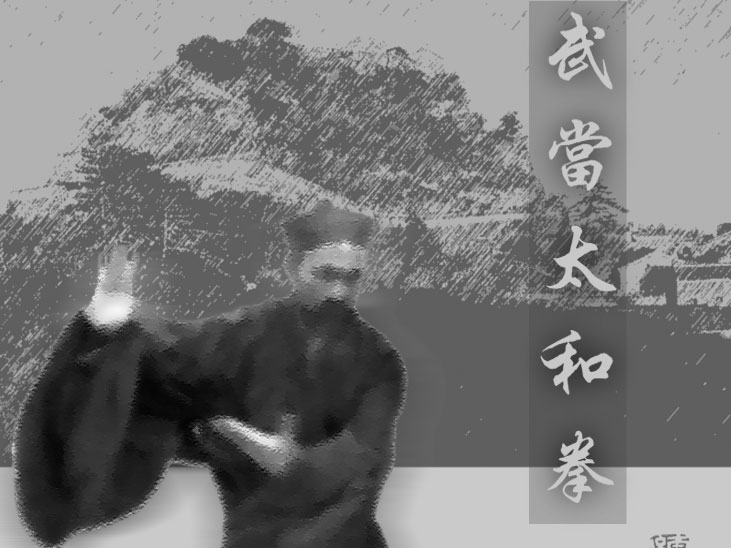
Verified by Zhang Sanfeng with the same name and pronunciation
2022-08-20 23:32:13
The main hall of Taizi Rock
Annotations on the 24 Poems of Jin Dan ⑥
2022-08-20 23:32:13
The tomb statue of Taoist Priest in Wulong Palace
Commentary on the Taiji Elixir Classic: "A Simple Explanation of Dao Yan" ①
2022-08-20 23:32:13
The white tiger in the Dragon and Tiger Hall of Fuzhen Templ...
"Xuan Yao Chapter - Part 1: A Song about Taoist Love.
2022-08-20 23:32:13
The dougong brackets in the main hall of Fuzhen Temple