


The Xinyi Liuhe Quan Internal Power Cultivation method
2022-08-20 23:32:13
I. What is the Inner Power of the Mind? The inner strength of Xinyi Quan is Dantian Gong, which is also known as "concentrating the mind on the Dantian". Focusing the mind on the dantian is the main method for cultivating internal strength in Xinyi Quan. The ancients said, "A distracted mind is the hardest to rein in." When the mind is focused on the dantian, it is hard to calm down and it is easy for all kinds of distractions to arise. The Xin Yi Quan is a dynamic exercise. When practiced, the whole body moves without the lower body moving. If one seeks stillness in movement and regulates the qi in the dantian during movement, through such long-term training, the internal strengthening goal of having sufficient qi in the dantian can be achieved. This kind of transforming meaning into form, refining meaning through form, and leading qi with meaning. The exercise of relying on the force of qi can make the essence, qi and spirit abundant, and the body movements quick, thereby achieving the goal of superior mental martial arts. Ii. What is the Dantian? The dantian can be classified into upper dantian, middle dantian and lower dantian. The upper dantian: Some say it is the Baihui point on the top of the head, some say it is on the eyebrows and the Yintang point, and some say it is on the philtrum. The middle dantian: It is said that the navel is the front dantian, and the Yangguan Mingmen is the back Dantian. Lower dantian: It is said to be located two cun above the navel, one and a half cun inside the navel, two cun below the navel, and one and a half cun below the navel. It is said to be in the perineum. It is said to be at the Yongquan point. Those who practice Xinyi Quan believe that the lower dantian refers to the Qihai point below the navel, which is the middle part of the human body, and one should focus their mind on this area. If you master this place well, "if you can cultivate the vital energy in your dantian, no one will be able to match you anywhere in the world." Iii. How to Practice? It can be specifically divided into the following steps: 1 In the morning (the hour of Yin is the best), choose a place with fresh air and pine and cypress trees (or by a lake or river). Stand naturally, with your left foot one step to the left, shoulder-width apart, parallel to each other. Slightly push your body down, bend your knees slightly, keep your head straight and your eyes straight, keep your body upright and your breath calm. When your shoulders are relaxed and you hang down, spread your fingers apart, with your palms facing inward and in front of your abdomen, and embrace each other as if holding a ball. At this moment, the body should be neither standing nor sitting, the face should be smiling, and the mind should be focused on the dantian area. Breathe freely and don't let your ears hear. Stand like this for a while and then move on to the next movement. 2 Stand upright with your left foot shoulder-width to the left. Focus your mind on the dantian. Then, use your mind to guide your qi. With the dantian as the center of the circle, rotate from left to right 36 times. Take a deep breath and swallow it. Then turn left from right for 36 circles, take a deep breath and swallow it. It is to transform the dantian. 3 Stand at attention with your dantian swaying. Take a step to the left with your left foot, shoulder-width apart. Relax your whole body and use your waist to drive the movement in a circular motion from left to right. But one should focus the mind on the dantian, taking it as the center of the circle. First, breathe freely. Then, shake your body in a circular motion from left to right. When your body shakes, inhale half a circle to the left. When inhaling, press your tongue against the palate. Exhale when your body turns to the right, and press your tongue against the lower palate as you exhale. However, when shaking, one should relax the shoulders and hips, and the whole body must not show the slightest sign of stiffness. This should be done approximately 36 times. Such parallel circular rotations can help exercise the Dai meridian. 4 To knead the dantian, stand with your feet straight in front of you. Take a step to the left with your left foot shoulder-width apart, and place your hands symmetrically on both sides of the dantian with your thumbs open. With the dantian as the center, make circular movements from left to right. Inhale with the tongue touching the hips (forming a magpie bridge), and exhale with the tongue touching the lower palate. About 36 times. 5 When striking the dantian, stand with your feet shoulder-width apart in front of you, relax your whole body, then extend your left foot half a step to the left front, and spread your arms backward with force like a bird spreading its wings, highlighting the wings of a white crane. Inhale from the top of your tongue against the palate. Then draw the left foot back and align it with the right foot. Turn both palms into fists and strike both sides of the dantian with force. Press the tongue against the lower hip and exhale. Count 36 times. 6 Starting from the light step of Zhe Dantian, take a left step up and cover the right cheek with the left palm. Take another right step forward and cover the left cheek with your right palm. Then, cross your palms and lunge forward together, prostrating your head as you lunge and exhaling for "prostrating the stele with your head". Inhale when you get up. In this way, the abdomen will be subjected to compression exercises and the dantian will also become full. 7 Take a wooden stool, sit down casually, place your right foot on the ground with the sole slanting forward, and press your left leg on top of your right leg. Place the palm of your left hand facing upwards on your left leg, and the palm of your right hand facing downwards. Bring both palms together and rub your right palm diagonally forward and downward from your left palm until you can no longer stretch your hand. Then exhale. Then, with the palm of your right hand facing upwards and the palm of your left hand facing downwards, pull your right palm back and inhale. Let the qi flow through your dantian. Repeat this 36 times. Then switch to landing with the left foot, with the sole diagonally facing forward. Place the right leg on top of the left leg, with the palm facing upwards, on the blind leg. With the left palm facing down and both palms together, rub the left palm diagonally forward and downward from the right palm until the hand can no longer be extended, then exhale. Then turn your left palm upwards and your right palm downwards. Pull your left palm back and inhale. Let the qi flow through your dantian. Repeat this 36 times. 8 Stand at attention with your feet together. Raise your palms from the sides of your hips, with the palms facing up, to your chest and cross them. Place your right hand on top of your left hand and inhale. Then they all pushed forward with all their might, "feeding the baby", Shouting "Drink" as they pushed out, exhaling, for a total of 36 times. 9 Stand at attention with the lower part of the body, hold the left hand high above the head with the palm of the right hand to the left, place the left palm at the base of the right palm, and lift the tips of both feet to inhale into the air. Then, as if both hands were being held with strong handles, pull them down together with all your might. Use your elbows to exert a downward force until both hands touch your chest. Exhale. Inhale and exhale in this way, for a total of 36 times. By forced breathing, the qi in the dantian becomes abundant and the internal qi surges, achieving the goal of internal strength. Only when the internal strength is abundant can the energy source be rich, the force be full and round, and inexhaustible. Fourth, the Effect of Dantian Gong: When practicing to a certain extent, one may feel a sense of heat in the dantian area or form a "qi" ascending sensation. This is a manifestation of the accumulation and storage of internal qi. Through further exercise, the "Dantian" qi will circulate throughout the body along the meridian system. You will feel a stream of hot air flowing down to the Huiyin point, then ascending to the Weiyan, Jiaji, Yuzhen, Baihui and other points of the Governor Vessel meridian, and then descending along the "Shanzhong" point of the Ren Vessel meridian to return to the "Dantian" point, creating a sensation of the circulation of qi from the Ren and Governor meridians. With further exercise, one can experience the sensation of internal qi circulating along the twelve meridians and the eight extraordinary meridians throughout the body. When one practices martial arts to this point, they will feel that the meridians and blood flow smoothly throughout their body, and they will be full of energy. When one reaches the advanced and superior level of martial arts, they can see without their eyes and hear without their ears. Even the tiniest things can be perceived and the faintest sounds can be heard. So, are you still worried about not being able to win the battle?
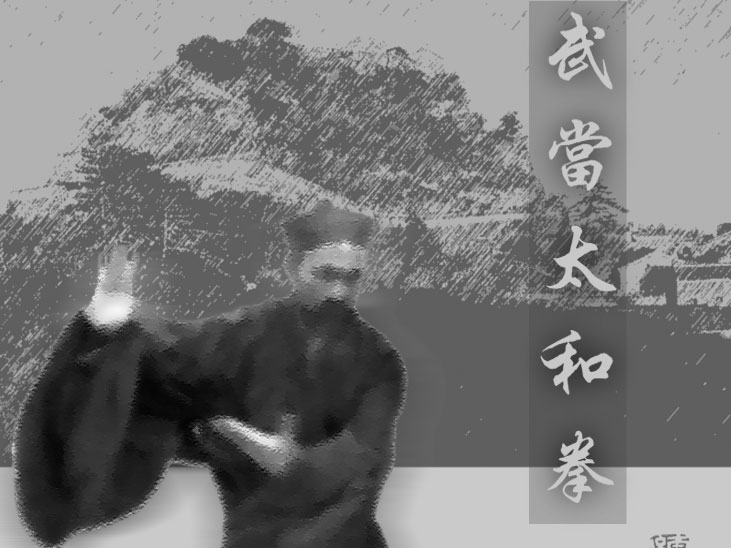
Evidence that Zhang Sanfeng created Tai Chi
2022-08-20 23:32:13
The plaque of the Golden Summit Lingguan Hall
Yan Men SAN Tang Zhong SAN Road
2022-08-20 23:32:13
The Golden Boy of the Wansheng Pavilion in Taihe Palace
Wudang snake-shaped sword
2022-08-20 23:32:13
The Jade Maiden of the Wansheng Pavilion in Taihe Palace
The hand of Yu Yu from the Dan Gong Sect
2022-08-20 23:32:13
Zhao Caishen in the Wansheng Pavilion of Taihe Palace
Zhang Sanfeng's original style Tai Chi
2022-08-20 23:32:13
Zhenwu of the Wansheng Pavilion in Taihe Palace