


A Brief History of Tai Chi Chuan - Wu-style Tai Chi Chuan
2022-08-20 23:32:13
In the late Qing Dynasty, Wu Yuxiang, a native of Yongnian, Hebei Province, fell in love with Yang Luchan's art after he returned to his hometown from Chenjiagou. He learned Yang Yu's Chen-style old frame Tai Chi and later learned Chen Qingping's Chen-style new frame. After some modifications, he created "Wu-style Tai Chi". Wu-style Tai Chi Chuan is distinct from both the old and new forms of Chen-style Tai Chi Chuan and the large and small forms of Yang-style Tai Chi Chuan. By learning and adapting them, one can form a unique school of their own. Its movements are simple and compact. Although the posture is small, it is not cramped. The movements are smooth and steady. The release of the hand does not exceed the toes, and the retraction is not close to the body. Each of the left and right hands controls half of the body, without crossing each other. The advance, retreat and rotation of the chest and abdomen should always be centered and upright. The footwork is strict, with a clear distinction between solid and void. It is small and flexible. When taking a step, the tips of the feet touch the ground first, and then the feet follow the ground and slowly lower to flatten the entire foot. In lunge, the knees of the front legs must not extend beyond the toes, and the back legs must not be straight and raised high. The boxing postures emphasize the beginning, continuation, opening and closing. The movements are smooth and continuous. The internal energy is transformed into the real and the void, and the "internal energy transformation" is used to control the external form. The principle of "the spirit should be restrained", "first in the mind, then in the body", "the mind governs the energy, the energy moves the body, the mind follows the movement, the mind follows the energy, and the mind follows the energy" is adopted to achieve the unity of mind, energy and form.
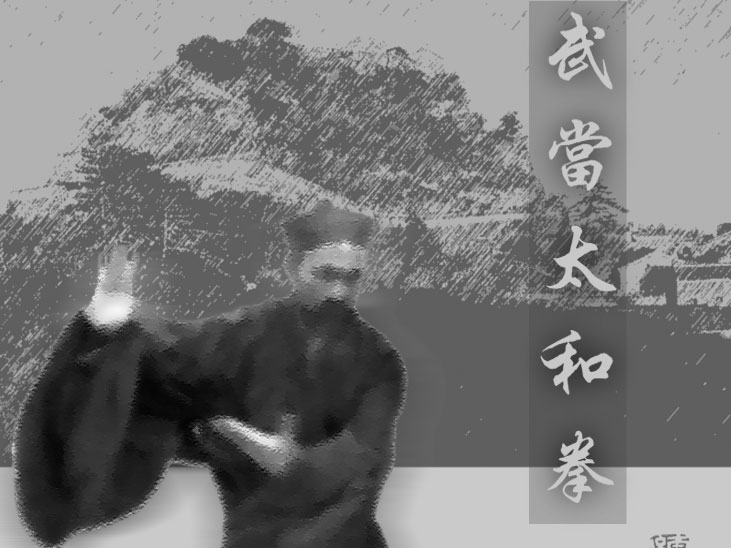
The hand of Yu Yu from the Dan Gong Sect
2022-08-20 23:32:13
Zhao Caishen in the Wansheng Pavilion of Taihe Palace
Zhang Sanfeng's original style Tai Chi
2022-08-20 23:32:13
Zhenwu of the Wansheng Pavilion in Taihe Palace
Wudang Divine Skill: Two-Finger Zen
2022-08-20 23:32:13
Taiqing in the Liangyi Hall of Nan Yan Palace
Verified by Zhang Sanfeng with the same name and pronunciation
2022-08-20 23:32:13
The main hall of Taizi Rock