


(1) The meaning of the ritual of fasting and Taoist ceremonies
2022-08-20 23:32:13
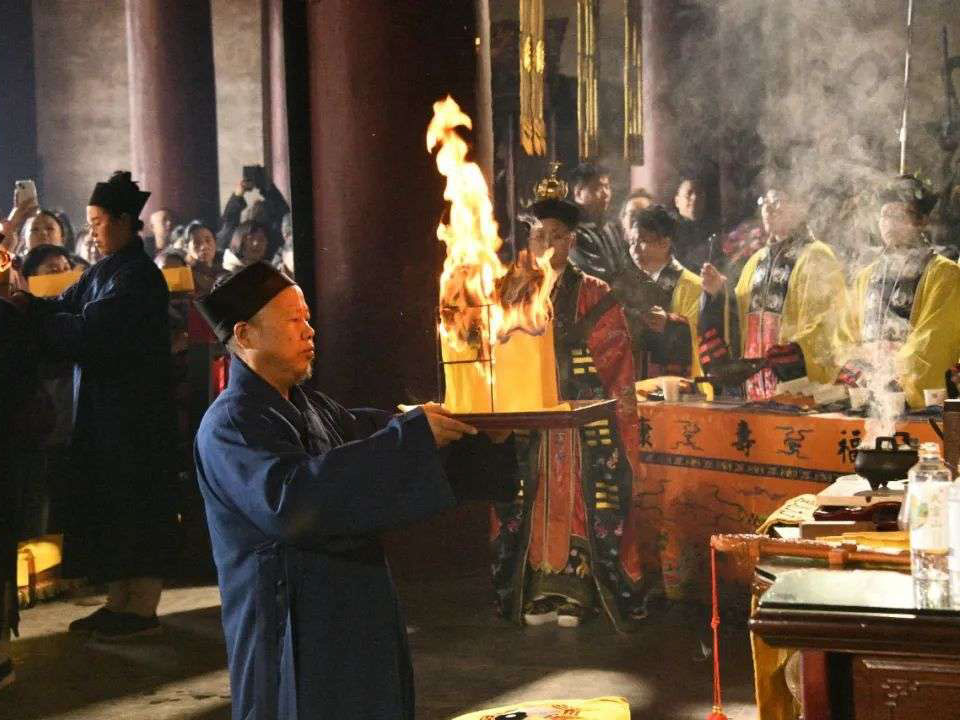
The original meaning of "zhai" was to be neat, harmonious and clean. Later, it came to mean fasting and purity. It indicates that before paying homage to ancestors, one must take a bath, change clothes, refrain from eating meat or alcohol, and not stay in the inner bed, to show the solemnity and sincerity of the worshiper. Taoism adopted this ritual. At the beginning of the prayer and expulsion, people ate vegetarian food to purify their minds and took baths to cleanse their bodies, which was called "Xiu Zhai". The initial purpose was to "accumulate virtue and eliminate faults", then to "harmonize with the spirit and preserve longevity", and later to "specialize in the way", "enjoy the Way", and "unite with the Way", which is called "cultivating the Way", and this is the highest realm of fasting. Therefore, Taoism attaches great importance to the practice of fasting and has formulated a complete set of fasting methods. According to its scale and function, it can be classified as follows: (1) Inner Meditation (the ultimate path) : including mental meditation, sitting in oblivion, storing thoughts, etc. (see "The Cave Nerve"). (2) Waizhai (Jidu) : It includes the three 箓 seven grades, the three 箓 refer to 金箓 zhai, jade 箓 zhai, and 黄箓 zhai. The Seven grades refer to Sanhuang Studio, Ziran Dai, Shangqing Studio, Zhijiao Studio, Tu Tan Studio, Mingzhen Studio, and Sanyuan Di (see "Dongxuan Lingbao Zhimen Dayi"). Various fasting methods have different meanings, such as the 金箓 fasting "to eliminate natural disasters and protect the emperor", the jade 箓 fasting "to save the people and bestow blessings and gratitude", and the 黄箓 fasting "to relieve the suffering of the netherworld", and so on. Nowadays, Taoists of the Quanzhen Sect still adhere to a vegetarian diet. In the Zhengyi school of Taoism, on the first and fifteenth days of the lunar month or other religious programs, vegetarian food is required, and so on. All of them are fasting to serve the Dharma. The original meaning of "jiao" is to offer sacrifices, which was an ancient ritual. The Shuowen Shuowen states that the first is the coronation and marriage, and the second is the sacrificial ceremony. Taoism has inherited and developed the sacrificial aspect of the Taoist ritual, using this method to interact with deities. "Jiao" also has its own "jiao method". The so-called "jiao Fa" refers to the procedures, rituals and other rules of the Jiao ceremony. There are many types of "jiao" (a kind of ritual). Generally speaking, whenever people have a need, there will be corresponding types of jiao, such as the Nine Dragons Jiao for Praying for Rain, the Zhengyi Transmission and Salvation Jiao, and the Luo Tian Da Jiao, etc. The fasting method and the Taoist ritual were originally different. Later, they merged with each other. After the Sui and Tang Dynasties, the term "fasting and Taoist ritual" was used together and has been passed down to this day, becoming a synonym for Taoist rituals. The "ritual of fasting and praying" refers to certain regulations on which the ritual and prayer activities are based. Generally, there are distinctions between "Yang" and "Yin" events, that is, between "Qing jiao" and "You Jiao". The Qingjiao ritual involves praying for blessings and expressing gratitude, curing diseases and prolonging life, welcoming good fortune to the country, praying for clear weather and rain, dispelling misfortunes and disasters, and celebrating birthdays. It is a kind of ritual similar to the Taiping Jiao. The ritual of the "Youjiao" is a kind of ritual for the deceased, such as bathing and crossing Bridges, breaking through prisons and lakes, and offering food for the deceased. On every new moon day, full moon day, important festivals, and the birthday of the patriarchs, Taoist monks in temples and monasteries hold birthday celebrations and other ceremonies. These regular rituals and regulations all fall under the category of sacrificial ceremonies.
One of the stars of the Big Dipper
2026-04-15 11:51:31
(1) The meaning of the ritual of fasting and Taoist ceremonies
2022-08-20 23:32:13
The original meaning of "zhai" was to be neat, harmonious an...
Yin GUI
2022-08-20 23:32:13
Chapter 72
2022-08-20 23:32:13
Chapter 27
2022-08-20 23:32:13
The chapter on Pain Relief
2022-08-20 23:32:13
Chapter Sixty
2022-08-20 23:32:13